Table of Contents
- Introduction
- What Is E-E-A-T?
- Why E-E-A-T Matters for SEO
- 1. Publish Original Content
- 2. Share First-Hand Experience
- 3. Add an Author Bio
- 4. Demonstrate Industry Expertise
- 5. Build Topical Authority
- 6. Keep Content Updated
- 7. Cite Reliable Sources
- 8. Display Contact Information
- 9. Secure Your Website
- 10. Improve Website Design and User Experience
- 11. Create Detailed About Us Pages
- 12. Showcase Certifications and Qualifications
- 13. Publish Case Studies
- 14. Collect Genuine Customer Reviews
- 15. Build High-Quality Backlinks
- 16. Strengthen Your Brand Presence
- 17. Improve Content Readability
- 18. Optimize for User Intent
- 19. Maintain Content Accuracy
- 20. Build a Strong Internal Linking Structure
- 21. Add Structured Data (Schema Markup)
- 22. Be Transparent About Your Business
- 23. Keep Your Website Technically Healthy
- 24. Build Your Personal Brand
- 25. Continuously Improve Your Content
- Common E-E-A-T Mistakes
- E-E-A-T Checklist
-
Frequently Asked Questions (FAQs)
- 1. What does E-E-A-T stand for?
- 2. Is E-E-A-T a Google ranking factor?
- 3. Why is E-E-A-T important for SEO?
- 4. How can I improve my website's E-E-A-T?
- 5. Does AI-generated content affect E-E-A-T?
- 6. What is the difference between Expertise and Experience?
- 7. Which websites benefit most from E-E-A-T?
- Conclusion
- Build a More Trustworthy Website with Expert SEO Services
Introduction
Google's search algorithms have evolved beyond simply matching keywords. Today, search engines prioritize content created by trustworthy, knowledgeable, and experienced sources. This is where E-E-A-T plays a crucial role.
E-E-A-T stands for Experience, Expertise, Authoritativeness, and Trustworthiness. It helps Google evaluate the overall quality and credibility of your content, especially for websites covering topics related to health, finance, legal advice, business, and other areas where accuracy matters.
Whether you run a business website, blog, eCommerce store, or service-based website, improving your E-E-A-T can increase user trust, strengthen your brand authority, and support long-term SEO performance.
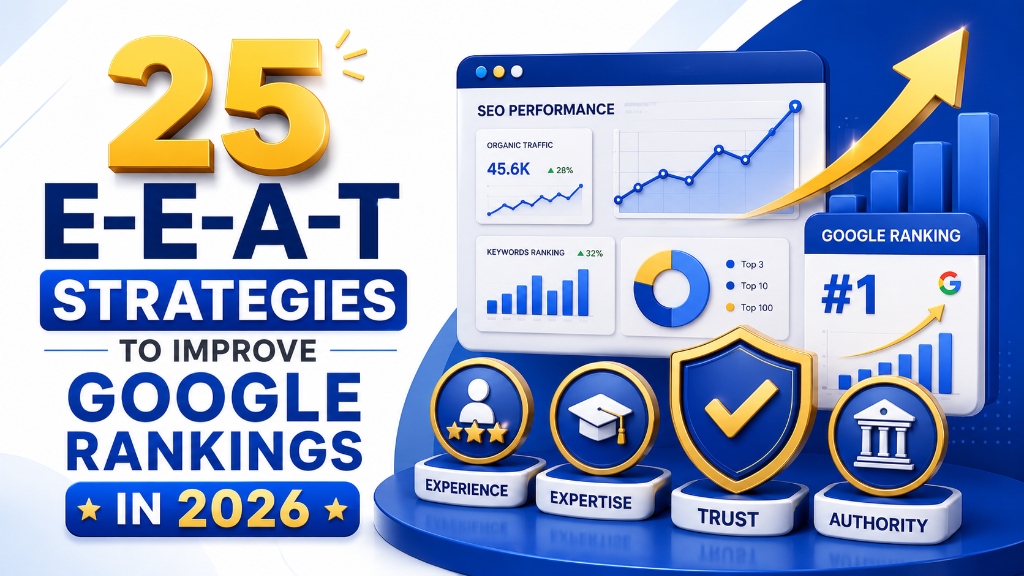
In this guide, you'll learn 25 E-E-A-T Strategies to Improve Google Rankings in 2026 and discover practical ways to create content that both users and search engines value.
What Is E-E-A-T?
E-E-A-T is Google's framework for evaluating the quality and reliability of website content.
It consists of four key components:
- Experience: Shows that the content creator has real-world, first-hand experience with the topic.
- Expertise: Demonstrates professional knowledge and subject expertise.
- Authoritativeness: Reflects how well-known and respected your website, brand, or author is within the industry.
- Trustworthiness: Measures whether users can rely on your content, website, and business.
Among these, Trust is considered the most important factor because it influences how users and search engines perceive your website.
Why E-E-A-T Matters for SEO
Improving E-E-A-T offers several long-term SEO benefits:
- Builds user trust
- Improves content credibility
- Strengthens brand authority
- Supports higher Google rankings
- Increases organic traffic
- Encourages natural backlinks
- Improves user engagement
- Enhances content quality
- Helps AI search engines understand your expertise
- Creates long-term SEO value
E-E-A-T isn't a direct ranking factor but contributes to many signals Google uses to evaluate content quality.
1. Publish Original Content
Create unique, informative content that provides real value instead of copying information from other websites.
Original content helps establish your expertise and builds trust with readers.
2. Share First-Hand Experience
Include personal insights, case studies, project examples, screenshots, or real results.
Content backed by real experience is more valuable than generic information.
3. Add an Author Bio
Every article should include a detailed author profile.
Mention your professional experience, certifications, skills, industry expertise, website, and social profiles. This helps users understand who created the content.
4. Demonstrate Industry Expertise
Publish content based on your professional knowledge. Instead of repeating basic information, explain concepts using practical examples and proven strategies.
5. Build Topical Authority
Cover your niche comprehensively. For example, if your website focuses on SEO, publish articles about Technical SEO, On-Page SEO, Local SEO, AI SEO, Schema Markup, Google Search Console, Google Analytics 4, and Core Web Vitals. A strong content cluster signals expertise to search engines.
6. Keep Content Updated
Review and refresh articles regularly. Update statistics, screenshots, examples, SEO strategies, Google updates, and internal links. Fresh content improves relevance and user trust.
7. Cite Reliable Sources
Support important claims with references from trusted sources whenever appropriate. Examples include Google Search Central, Google Developers, government websites, universities, industry research, or official documentation. Reliable references improve content credibility.
8. Display Contact Information
Business websites should clearly display a contact page, email address, phone number, and physical office address (if applicable). Easy-to-find contact information builds confidence.
9. Secure Your Website
Trust starts with website security. Ensure your website uses HTTPS, valid SSL certificates, secure contact forms, safe payment gateways, and clear privacy protection. Visitors are more likely to trust secure websites.
10. Improve Website Design and User Experience
A professional-looking website creates a positive first impression. Focus on clean layouts, fast loading pages, mobile responsiveness, easy navigation, and accessible design. A better user experience supports both trust and engagement.
11. Create Detailed About Us Pages
Your About Us page should clearly explain your company background, mission and values, years of experience, services offered, team profiles, and industry expertise. A transparent About page helps users and search engines understand your business.
12. Showcase Certifications and Qualifications
If you hold professional certifications, display them on your website. Examples include Google Certifications, HubSpot Certifications, Meta Certifications, Microsoft Certifications, or other industry-specific qualifications. These credentials strengthen your expertise and credibility.
13. Publish Case Studies
Share real-world examples of your work. Include client challenges, your solution, results achieved, screenshots, and performance improvements. Case studies demonstrate practical experience and build trust with potential clients.
14. Collect Genuine Customer Reviews
Authentic customer feedback improves your website's credibility. Encourage satisfied customers to leave reviews on Google Business Profile, Trustpilot, Clutch, Facebook, or industry-specific review platforms. Always respond professionally to reviews.
15. Build High-Quality Backlinks
Earn backlinks from reputable and relevant websites. Focus on guest blogging, industry publications, digital PR, resource pages, and expert interviews. Quality backlinks strengthen your website's authoritativeness.
16. Strengthen Your Brand Presence
Maintain a consistent brand across all online platforms. Ensure consistency in your logo, business name, contact details, website, and social media profiles. A strong brand presence reinforces trust and recognition.
17. Improve Content Readability
Well-structured content keeps visitors engaged. Best practices include short paragraphs, clear headings, bullet points, numbered lists, simple language, and relevant visuals. Easy-to-read content improves user experience and retention.
18. Optimize for User Intent
Create content that directly answers what users are searching for, whether they have informational, navigational, commercial, or transactional intent. Meeting user intent increases engagement and satisfaction.
19. Maintain Content Accuracy
Review your articles regularly to ensure all information remains accurate and relevant. Update statistics, industry trends, Google algorithm changes, broken links, and outdated examples. Accurate content builds long-term trust.
20. Build a Strong Internal Linking Structure
Connect related articles throughout your website. For example, link Technical SEO, Google Search Console, AI SEO, Schema Markup, Core Web Vitals, and Local SEO. Internal linking improves navigation, topical authority, and content discovery.
21. Add Structured Data (Schema Markup)
Implement relevant schema types to help search engines understand your content. Useful schema includes Article, Person, Organization, FAQ, Breadcrumb, and Local Business. Structured data can improve search visibility and enhance rich results.
22. Be Transparent About Your Business
Clearly communicate important business information. Include a Privacy Policy, Terms and Conditions, Refund Policy, contact details, business address, and company registration details. Transparency helps build trust with both users and search engines.
23. Keep Your Website Technically Healthy
Regular technical maintenance improves both user experience and search performance. Monitor broken links, crawl errors, page speed, mobile usability, indexing issues, and Core Web Vitals. A technically sound website supports credibility and long-term SEO success.
24. Build Your Personal Brand
Establish yourself as an industry expert by sharing valuable insights. You can build authority through blogging, speaking at events, hosting podcasts, publishing LinkedIn posts, conducting webinars, or writing guest articles. A recognizable personal brand strengthens overall E-E-A-T signals.
25. Continuously Improve Your Content
E-E-A-T is an ongoing process rather than a one-time task. Regularly publish new content, refresh existing articles, expand topic coverage, monitor performance, improve user experience, and gather customer feedback to maintain relevance and authority over time.
Common E-E-A-T Mistakes
Avoid these common mistakes that can weaken your website's credibility and SEO performance:
- Publishing AI-Generated Content Without Review: AI can assist with content creation, but every article should be reviewed, fact-checked, and enhanced with original insights before publishing.
- Hiding Author Information: Articles without a clear author profile can reduce user confidence. Include author bios that highlight relevant experience and expertise.
- Using Outdated Content: Old statistics, broken links, and obsolete recommendations can reduce trust. Update important pages regularly.
- Making Unsupported Claims: Avoid exaggerated or unverified statements. Support claims with real examples, credible sources, or data where appropriate.
- Ignoring Website Security: A secure website using HTTPS, valid SSL certificates, and safe forms is essential for building trust.
- Weak About and Contact Pages: Missing business information can make a website appear less trustworthy. Ensure visitors can easily learn who you are and how to contact you.
- Neglecting User Experience: Slow loading pages, confusing navigation, and poor mobile usability can negatively affect user trust and engagement.
E-E-A-T Checklist
Use this checklist to strengthen your website's Experience, Expertise, Authoritativeness, and Trustworthiness:
- Publish original, valuable content
- Share first-hand experience
- Add detailed author bios
- Demonstrate subject expertise
- Build topical authority
- Update content regularly
- Reference reliable sources
- Display clear contact information
- Secure your website with HTTPS
- Improve website design and usability
- Create a comprehensive About Us page
- Showcase certifications and credentials
- Publish case studies
- Collect genuine customer reviews
- Earn high-quality backlinks
- Strengthen your brand presence
- Improve content readability
- Match user search intent
- Maintain content accuracy
- Build strong internal links
- Implement schema markup
- Be transparent about your business
- Monitor technical SEO health
- Build your personal brand
- Continuously improve and expand your content
Frequently Asked Questions (FAQs)
E-E-A-T stands for Experience, Expertise, Authoritativeness, and Trustworthiness. It is Google's framework for evaluating the quality and credibility of content. Websites that demonstrate strong E-E-A-T are more likely to build user trust and perform well in search results.
E-E-A-T is not a direct ranking factor like page speed or mobile usability. Instead, it represents a set of quality signals Google uses to evaluate whether content is reliable, helpful, and trustworthy. Improving E-E-A-T supports better SEO performance over time.
Strong E-E-A-T helps your website:
• Build user trust
• Improve brand credibility
• Increase content quality
• Earn high-quality backlinks
• Improve user engagement
• Support long-term Google rankings
It's especially important for websites that publish information related to health, finance, legal services, education, and business.
Some of the best ways include:
• Publish original content
• Share first-hand experience
• Add detailed author profiles
• Build topical authority
• Keep content updated
• Earn quality backlinks
• Display trust signals
• Improve website security
• Use schema markup
• Showcase customer reviews and case studies
Consistency is key to building long-term credibility.
AI can help create content, but it should always be reviewed and improved by a knowledgeable human. Add original insights, practical examples, accurate information, and first-hand experience to ensure the content provides real value.
Experience refers to real-world, first-hand involvement with a topic. Expertise refers to the knowledge, skills, or qualifications needed to explain a subject accurately. The strongest content combines both experience and expertise to provide valuable information.
E-E-A-T benefits every website, including:
• Business websites
• Service providers
• E-commerce stores
• Blogs
• News websites
• Educational websites
• SaaS companies
• Local businesses
• Digital marketing agencies
• Personal brand websites
Any website aiming to build trust and authority can benefit from improving its E-E-A-T.
Conclusion
Building a successful website today requires more than keyword optimization. Google increasingly rewards websites that provide reliable, helpful, and trustworthy content created by people with genuine knowledge and experience.
By implementing these 25 E-E-A-T Strategies, you can strengthen your website's credibility, improve user confidence, and create content that stands out in competitive search results. From publishing original articles and showcasing your expertise to improving technical SEO and earning quality backlinks, every step contributes to long-term organic growth.
Remember that E-E-A-T is an ongoing commitment. Continue refining your content, expanding your topical authority, and maintaining transparency to ensure your website remains valuable to both users and search engines.
Build a More Trustworthy Website with Expert SEO Services
Creating high-quality content is only one part of SEO. Building Experience, Expertise, Authoritativeness, and Trustworthiness (E-E-A-T) across your website helps strengthen your online presence and improve long-term search visibility.
At balamurugan.in, we help businesses build trusted websites that perform well in Google Search and AI-powered search experiences.