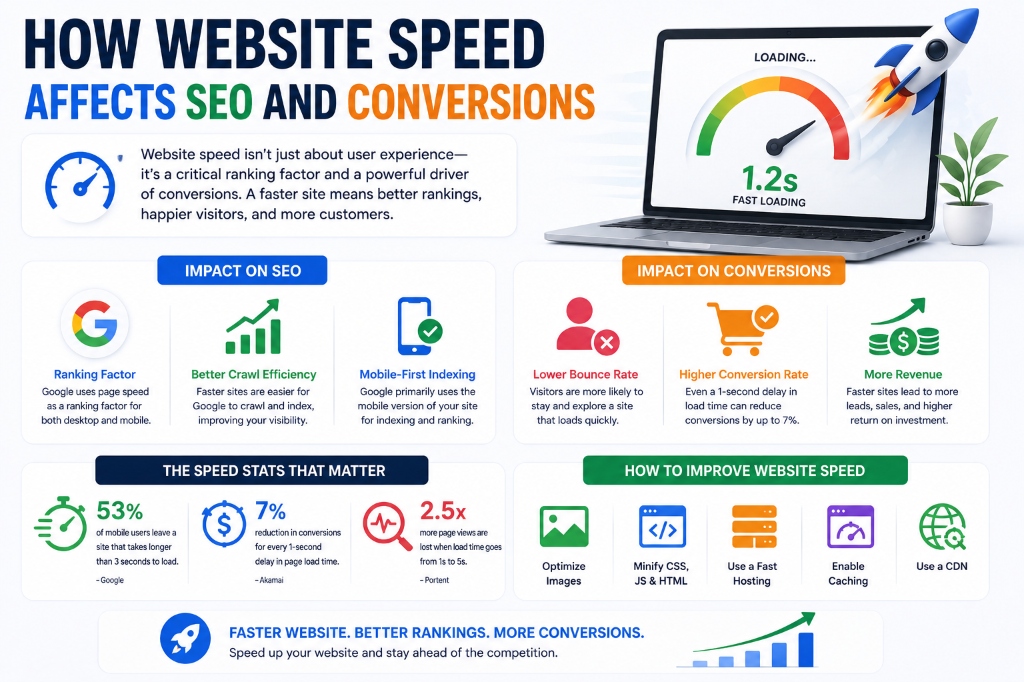
In our fast-paced digital landscape, speed is key. If a website takes longer than 3 seconds to load, over 50% of visitors will abandon it. Website speed is not just a user experience factor; it is a critical SEO ranking factor that directly impacts conversions.
This article explains how speed affects your Google rankings and conversion rates, and how to improve performance.
1. Speed is a Core Google Ranking Signal
Google's Core Web Vitals measure the loading experience of web pages. Largest Contentful Paint (LCP) tracks when the main page content has loaded, First Input Delay (FID) tracks responsiveness, and Cumulative Layout Shift (CLS) tracks visual stability.
2. Faster Speeds Increase Conversion Rates
Every fraction of a second matters. Studies prove that a 1-second delay in page load time can reduce conversions by up to 20%. A faster website keeps users engaged, leading to higher page views and form submissions.
3. The Psychological Impact of Latency
Users equate website speed with business professionalism. A slow loading website raises security doubts, prompting users to bounce. A fast, responsive layout creates instant brand trust.
| Page Load Speed | Average Bounce Rate | Conversion Impact |
|---|---|---|
| Under 1.5 seconds | 9.6% bounce rate | Optimal Conversion (Baseline) |
| 1.5 to 3.0 seconds | 15.2% bounce rate | -10% Conversions |
| 3.0 to 5.0 seconds | 38% bounce rate | -35% Conversions |
| Over 5.0 seconds | 70%+ bounce rate | -60%+ Conversions |
"Speed is the foundation of digital conversions. If your website is slow, you are paying for ad clicks only to watch users bounce before the page loads."
4. Optimize Images and Formats
Large images are the primary cause of slow load times. Convert images to modern formats like WebP or PNG, compress them before uploading, and implement lazy loading to defer loading off-screen assets.
5. Leverage Browser Caching and CDNs
Caching stores elements of your website in visitors' browsers, making return visits instantaneous. A Content Delivery Network (CDN) distributes website assets to servers globally, delivering data from the closest node.
Key Takeaway
Run your website through Google PageSpeed Insights. If your mobile performance score is below 80, your site is losing organic visibility.
By focusing on these core elements, Balamurugan P helps brands scale their monthly traffic and achieve sustainable growth. Let's start optimizing your online visibility today.
Frequently Asked Questions
Google uses Core Web Vitals to measure page performance. Slow page loads increase user bounce rates, which negatively impacts organic rankings.
Three metrics: Largest Contentful Paint (load speed), Cumulative Layout Shift (visual stability), and Interaction to Next Paint (responsiveness).
Compress images, host videos externally, leverage browser caching, minify CSS and JS files, and use a fast Content Delivery Network (CDN).