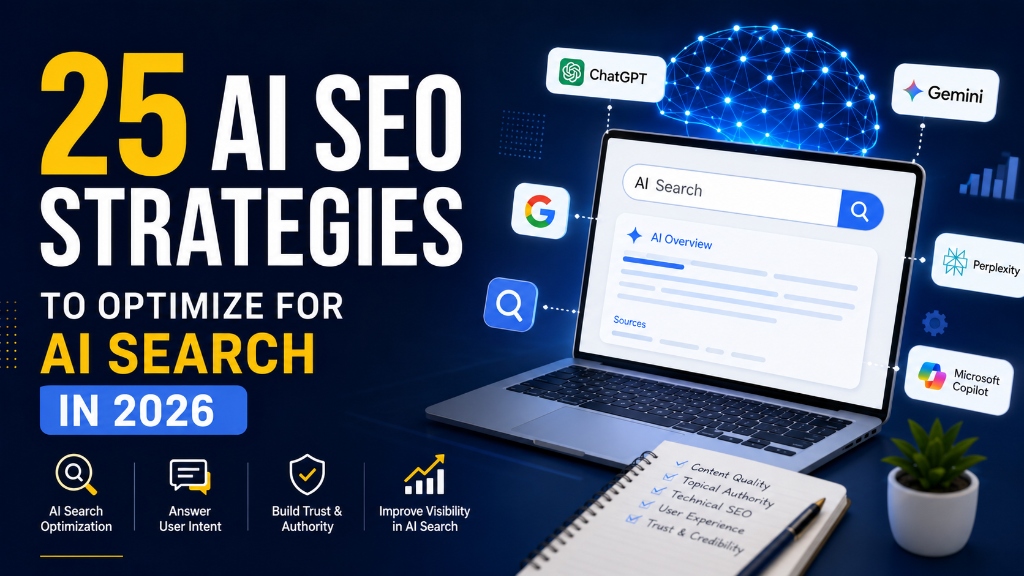
Search is evolving faster than ever. For years, SEO focused primarily on ranking webpages in traditional search engine results. Businesses optimized keywords, built backlinks, improved website speed, and created valuable content to appear higher in Google Search.
While those fundamentals remain essential, the way people search for information is changing.
Today, users increasingly rely on Google AI Overviews, ChatGPT, Gemini, Microsoft Copilot, Perplexity AI, and other AI-powered search platforms to get quick, conversational answers instead of browsing through multiple websites.
Rather than displaying only a list of links, AI search engines summarize information, compare sources, and generate direct responses based on content they consider reliable and authoritative.
This shift creates both new opportunities and new challenges for website owners. The goal is no longer just to rank on the first page of search results. It's also to become a trusted source that AI systems choose when generating answers.
This is where AI SEO becomes important.
AI SEO combines traditional SEO best practices with strategies designed to improve your website's visibility in AI-powered search experiences. It focuses on creating trustworthy, well-structured, comprehensive, and easy-to-understand content that both search engines and AI models can interpret confidently.
Whether you're a business owner, blogger, SEO professional, digital marketer, or content creator, understanding AI SEO will help you stay competitive as search continues to evolve.
In this guide, you'll learn 25 practical AI SEO strategies to help optimize your website for AI-powered search in 2026.
What Is AI SEO?
AI SEO is the process of optimizing your website so that AI-powered search engines can better understand, trust, and reference your content.
Unlike traditional SEO, which focuses mainly on improving rankings in search engine results pages (SERPs), AI SEO aims to make your content more useful for systems that generate direct answers.
Examples include:
- Google AI Overviews
- ChatGPT Search
- Google Gemini
- Microsoft Copilot
- Perplexity AI
These systems analyze multiple trusted sources before generating responses. AI SEO helps your content become one of those trusted sources.
It includes optimizing content quality, website structure, technical SEO, entity recognition, topical authority, user experience, and structured data. Rather than replacing traditional SEO, AI SEO builds upon it.
Why AI SEO Matters in 2026
AI-powered search continues to reshape how users discover information online. Here are some reasons why AI SEO has become increasingly important:
Search Behavior Is Changing
Many users now ask conversational questions instead of typing short keywords. AI systems respond with summarized answers instead of only displaying website links.
Visibility Beyond Traditional Rankings
Your content may be referenced by AI-generated answers even if users never visit a traditional search results page. Being cited by AI systems can increase your brand's visibility and credibility.
Greater Focus on Trust
AI models prioritize information from reliable, accurate, and authoritative sources. Building trust has become more important than simply targeting keywords.
Better User Experience
AI search rewards websites that provide clear explanations, helpful content, accurate information, logical structure, and strong expertise. Improving these areas benefits both users and search engines.
Future-Proof Your SEO Strategy
As AI becomes a larger part of search, websites that adapt early will be better positioned for long-term success.
Traditional SEO vs AI SEO
Although AI SEO builds on traditional SEO, there are several important differences.
| Traditional SEO | AI SEO |
|---|---|
| Focuses on search rankings | Focuses on becoming a trusted AI source |
| Targets keywords | Answers user intent comprehensively |
| Optimizes pages | Optimizes knowledge and context |
| Earns backlinks | Builds authority and trust |
| Improves SERP visibility | Improves AI citation visibility |
| Optimizes for search engines | Optimizes for search engines and AI systems |
The strongest SEO strategies combine both approaches rather than treating them as separate disciplines.
25 AI SEO Strategies
Below are the most effective AI SEO strategies for improving visibility in AI-powered search during 2026.
1. Create Helpful, People-First Content
AI systems prioritize content that genuinely helps users. Focus on creating content that solves problems, answers questions, explains concepts clearly, and provides practical value. Avoid writing solely for search engines.
2. Demonstrate Experience and Expertise
AI systems increasingly evaluate content quality. Whenever appropriate, share real experiences, include practical examples, explain processes, and reference credible sources. Content created from genuine expertise builds greater trust.
3. Build Strong Topical Authority
Instead of publishing isolated articles, create clusters of related content. Topics like Technical SEO, Core Web Vitals, Schema Markup, Internal Linking, Website Speed, and AI SEO should interlink to show deep topic coverage.
4. Answer Questions Clearly
AI search frequently responds to conversational queries. Structure your content around questions users commonly ask (like What is AI SEO? or Why is AI SEO important?) to increase the likelihood of being referenced.
5. Optimize for Search Intent
Every page should satisfy a specific search intent. Determine whether users are looking for information, comparisons, tutorials, services, or products. Content that fully satisfies intent performs better in both search models.
6. Use Clear Heading Structure
Well-organized content is easier for both users and AI systems to understand. Follow a logical hierarchy (H1, H2, H3, H4) with descriptive headings to improve readability and information extraction.
7. Write Simple and Easy-to-Understand Content
AI models prefer content that communicates ideas clearly. Use short paragraphs, simple language, bullet points, numbered lists, and clear explanations, avoiding unnecessary complexity.
8. Strengthen Entity Recognition
AI search understands entities more effectively than keywords alone. Clearly identify brands, products, services, locations, organizations, and people to improve contextual understanding.
9. Implement Structured Data
Schema Markup helps AI systems interpret your content more accurately. Implement relevant structured data such as Article, Organization, FAQ, Breadcrumb, and Person Schema to improve machine readability.
10. Build Website Trust
Trust has become one of the most valuable SEO assets. Strengthen trust by publishing accurate information, updating content regularly, displaying author information, maintaining HTTPS security, and citing reliable sources.
11. Optimize for Conversational Search Queries
AI-powered search platforms are designed to understand natural language. Instead of focusing only on short keywords, create content that answers conversational questions users actually ask, which aligns better with how people interact with AI assistants.
12. Publish Comprehensive Topic Guides
AI systems prefer complete, in-depth resources over thin content. Create guides that fully cover a subject, including definitions, benefits, best practices, common mistakes, step-by-step instructions, and FAQs.
13. Keep Content Fresh and Updated
AI-powered search favors accurate and up-to-date information. Regularly review your content to update statistics, refresh screenshots, add new examples, remove outdated information, and improve readability.
14. Use Internal Linking Strategically
Internal links help AI systems understand the relationships between topics on your website. For example, an AI SEO article can naturally link to Technical SEO, Schema Markup, or Core Web Vitals to strengthen topical authority.
15. Build Author Credibility
AI search places greater emphasis on content credibility. Include the author's name, a professional bio, relevant experience, and contact info to establish author authority and trust.
16. Improve Website Speed
Fast websites provide a better user experience and support AI SEO. Focus on faster loading pages, compressed images, reduced JavaScript, better hosting, browser caching, and CDNs.
17. Optimize Core Web Vitals
Core Web Vitals remain an important part of overall website quality. Regularly monitor LCP, INP, and CLS to ensure a superior page experience.
18. Optimize for Mobile Users
Most searches now happen on mobile devices. Ensure your website uses responsive design, loads quickly, displays correctly on all screen sizes, and uses touch-friendly navigation.
19. Build High-Quality Backlinks
Backlinks remain one of the strongest trust signals. Focus on earning links from industry blogs, news sites, educational resources, and trusted organizations to strengthen your site's reputation.
20. Add Frequently Asked Questions (FAQs)
FAQs help answer common user questions in a clear and structured format. They provide better readability, improved content coverage, easier information extraction, and an enhanced user experience.
21. Optimize for Entity-Based SEO
Modern AI search understands entities rather than just keywords. Clearly identify brands, products, services, locations, and organizations to help AI understand your content more accurately.
22. Publish Original Insights
AI systems value unique perspectives. Include personal experiences, case studies, original research, and practical recommendations to help differentiate your content.
23. Monitor AI Search Trends
AI-powered search evolves rapidly. Stay informed about developments related to Google AI Overviews, ChatGPT Search, Gemini, Copilot, and Perplexity AI to keep your strategy current.
24. Measure AI SEO Performance
Track how your content performs over time. Review metrics such as organic traffic, user engagement, click-through rate (CTR), search visibility, and brand mentions to identify opportunities for improvement.
25. Continue Learning and Adapting
AI SEO is constantly evolving. Successful websites continuously publish helpful content, improve technical SEO, expand topical authority, and refine content based on user needs.
Common AI SEO Mistakes
Many websites struggle to appear in AI-powered search because they rely on outdated SEO practices. Avoid these common mistakes:
- Writing Only for Search Engines: Content should be created for people first, not algorithms.
- Ignoring Search Intent: Answer the user's question completely instead of simply targeting keywords.
- Publishing Thin Content: Short, low-value pages execution rarely become trusted AI references.
- Neglecting Technical SEO: Slow websites, crawl issues, and poor mobile experiences reduce overall content quality.
- Failing to Update Content: Outdated information reduces trust. Review and refresh your content regularly.
- Ignoring Structured Data: Schema Markup helps AI systems understand your content more accurately.
- Building Weak Topical Authority: Publishing random, unrelated articles makes it harder for AI systems to recognize your expertise.
Final AI SEO Checklist
Before publishing your content, review this checklist:
- Helpful, people-first content created
- Real experience and expertise demonstrated
- Strong topical authority established
- User questions answered clearly
- Search intent matched
- Logical heading structure used
- Clear and easy-to-read content written
- Entity recognition strengthened
- Schema Markup implemented
- Website trust strengthened
- Conversational search queries addressed
- Comprehensive topic guides published
- Content updated regularly
- Internal linking optimized
- Author credibility displayed
- Website speed improved
- Core Web Vitals optimized
- Mobile-friendly design ensured
- High-quality backlinks earned
- Frequently asked questions added
- Entity-based SEO focused
- Original insights and case studies shared
- AI search developments monitored
- SEO performance measured regularly
- Continuous content improvement planned
Frequently Asked Questions (FAQs)
1. What is AI SEO?
AI SEO is the practice of optimizing your website so it performs well in both traditional search engines and AI-powered search platforms such as Google AI Overviews, ChatGPT Search, Google Gemini, Microsoft Copilot, and Perplexity AI. It combines traditional SEO fundamentals with strategies that help AI systems better understand, trust, and reference your content.
2. Is AI SEO replacing traditional SEO?
No. AI SEO is not replacing traditional SEO—it is an evolution of it. Traditional SEO practices such as high-quality content, technical SEO, internal linking, website speed, Core Web Vitals, and backlinks remain essential. AI SEO builds on these fundamentals by improving content structure, topical authority, and trustworthiness for AI-powered search experiences.
3. How can I optimize my website for AI search?
To improve visibility in AI-powered search, focus on creating people-first content, demonstrating expertise and experience, building topical authority, using structured data, improving website speed, optimizing Core Web Vitals, strengthening internal linking, publishing original insights, and updating content regularly. The goal is to become a trusted source that AI systems are more likely to reference.
4. Does Schema Markup help AI SEO?
Yes. Schema Markup helps AI systems and search engines understand your website more accurately. Implementing structured data such as Article, Organization, FAQ, Breadcrumb, Person, or LocalBusiness Schema improves machine readability and provides additional context about your content.
5. Are backlinks still important for AI SEO?
Absolutely. Backlinks remain one of the strongest trust signals for search engines. AI-powered search platforms are more likely to reference content from websites that demonstrate authority through high-quality backlinks, strong topical expertise, helpful content, and positive user experience. Quality is far more important than quantity.
6. How often should I update AI SEO content?
AI search evolves rapidly, so regular updates are essential. Review your content every 3–6 months, after major Google updates, when AI search features change, when new industry data becomes available, or whenever information becomes outdated. Fresh, accurate content is more likely to remain relevant in both traditional and AI-powered search.
Conclusion
Artificial intelligence is transforming how people discover information online. Instead of simply presenting a list of blue links, AI-powered search platforms now analyze multiple trusted sources to generate direct, conversational answers. This shift means that modern SEO is no longer just about ranking—it is about becoming a reliable source that AI systems choose to reference.
The 25 AI SEO Strategies covered in this guide provide a practical framework for adapting to this new search landscape. By creating helpful content, building topical authority, strengthening technical SEO, implementing structured data, and focusing on user experience, you can improve your website's visibility across both traditional search engines and AI-powered platforms.
Remember that AI SEO is not a shortcut or a replacement for proven SEO practices. It builds upon the fundamentals that have always mattered—quality content, technical excellence, trust, and authority. Websites that consistently provide accurate, well-structured, and valuable information will be better positioned to succeed as AI search continues to evolve.
The future of SEO belongs to websites that prioritize users first. If your content genuinely helps people solve problems and answers their questions clearly, you'll be well prepared for both today's search engines and tomorrow's AI-driven experiences.
Prepare Your Website for the Future of Search
AI-powered search is changing how people discover information, but one principle remains the same: websites that provide genuine value will continue to succeed. By applying the strategies in this guide, you can create content that is easier for both people and AI systems to understand, increasing your chances of being discovered across traditional search results and AI-generated answers.
At balamurugan.in, you'll find in-depth SEO guides, practical checklists, and professional SEO services designed to help businesses grow their online presence and stay ahead of the latest search trends.