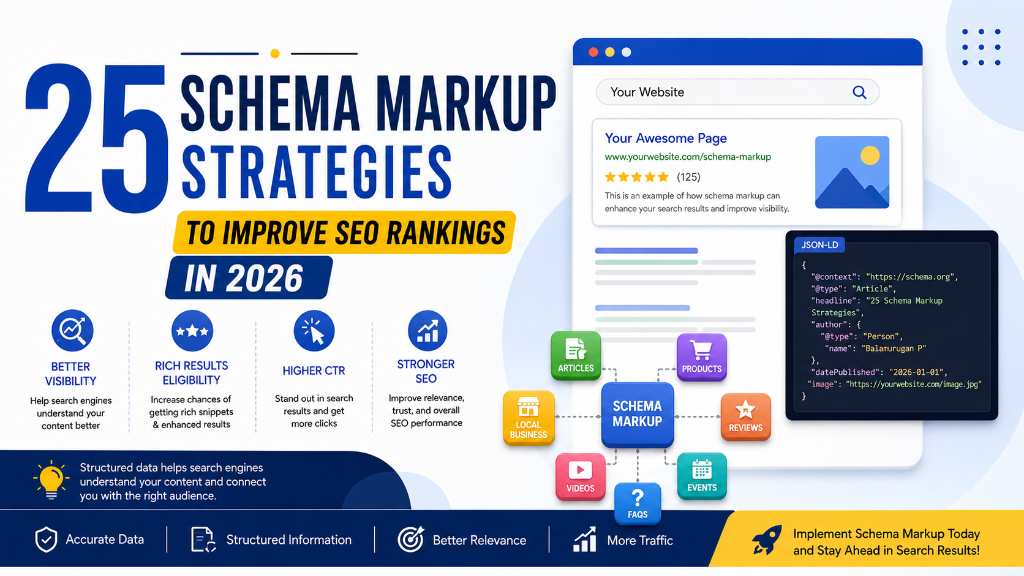
Search Engine Optimization has evolved far beyond simply adding keywords to your content. Today, search engines aim to understand the meaning behind every webpage so they can deliver the most relevant results to users.
This is where Schema Markup plays an important role.
Schema Markup, also known as structured data, provides additional information about your website that helps search engines understand your content more accurately. Whether you're publishing blog posts, offering services, selling products, or running a local business, implementing the right schema can improve how your pages appear in Google Search.
Many website owners invest time creating high-quality content but overlook structured data. As a result, they miss opportunities to earn rich results such as star ratings, FAQs, breadcrumbs, product information, event details, and other enhanced search features.
In 2026, Google continues to prioritize helpful, well-structured content that delivers a better search experience. While Schema Markup isn't a direct ranking factor, it can improve visibility, increase click-through rates (CTR), and help search engines interpret your website more effectively.
Whether you're an SEO professional, digital marketer, blogger, WordPress developer, or business owner, understanding Schema Markup is becoming an essential part of Technical SEO.
In this guide, you'll learn 25 practical Schema Markup strategies that can help improve your website's visibility, qualify for rich results, and strengthen your overall SEO performance in 2026.
Table of Contents
- What Is Schema Markup?
- Why Schema Markup Is Important
- How Schema Markup Helps SEO
-
25 Schema Markup Strategies
- 1. Understand What Schema Markup Is
- 2. Use JSON-LD Format
- 3. Validate Your Structured Data
- 4. Add Organization Schema
- 5. Implement Website Schema
- 6. Use Breadcrumb Schema
- 7. Add Article Schema for Blog Posts
- 8. Use BlogPosting Schema
- 9. Implement ImageObject Schema
- 10. Add FAQ Schema (Where Appropriate)
- 11. Add LocalBusiness Schema
- 12. Implement Product Schema
- 13. Use Service Schema
- 14. Add Review Schema
- 15. Implement AggregateRating Schema
- 16. Add VideoObject Schema
- 17. Use Event Schema
- 18. Implement Person Schema
- 19. Add Author Schema
- 20. Implement SearchAction Schema
- 21. Keep Schema Updated
- 22. Avoid Spammy Schema Markup
- 23. Monitor Rich Results in Google Search Console
- 24. Test Schema After Every Website Update
- 25. Expand Schema Across Your Website
- Common Schema Markup Mistakes
- Schema Markup Checklist
- Frequently Asked Questions (FAQs)
- Conclusion
What Is Schema Markup?
Schema Markup is a type of structured data that helps search engines understand the meaning and context of your webpage. Instead of simply reading text, Schema provides additional information about your content using a standardized vocabulary developed by Schema.org.
For example, a webpage about a product can tell Google:
- Product Name
- Brand
- Price
- Availability
- Reviews
- Ratings
- Images
Similarly, a blog post can provide information such as:
- Author
- Publish Date
- Featured Image
- Article Category
- Publisher
This structured information helps search engines display richer and more informative search results. Schema Markup is commonly implemented using JSON-LD, Google's recommended structured data format.
Why Schema Markup Is Important
Schema Markup helps search engines better understand your website, making it easier for them to display your content in enhanced search results. Some of its biggest benefits include:
Improve Search Visibility
Structured data increases your chances of appearing with enhanced search features that attract more attention.
Qualify for Rich Results
Depending on your content, Schema Markup may help your pages appear with Star Ratings, Product Information, FAQs, Breadcrumbs, Images, Events, Reviews, and Videos. Rich results often receive higher click-through rates than standard search listings.
Improve Search Engine Understanding
Schema provides clear information about your pages, reducing ambiguity and helping search engines interpret your content more accurately.
Enhance User Experience
Rich search results give users more useful information before they even visit your website, improving the overall search experience.
Support AI-Powered Search
Modern AI-driven search systems rely heavily on structured information to understand entities, relationships, and content context. Implementing Schema helps make your website more understandable for both traditional search engines and AI-powered search experiences.
How Schema Markup Helps SEO
Although Schema Markup is not a direct ranking factor, it contributes to better SEO in several important ways:
Better Content Understanding
Schema clearly explains what your webpage is about. For example, Google can easily identify whether a page represents a Blog Post, a Product, a Service, a Business, a Person, an Event, a Recipe, or a Video. This improves Google's ability to match your content with relevant searches.
Improved Click-Through Rate (CTR)
Rich results are visually more attractive than standard search listings. Features like ratings, FAQs, product details, breadcrumbs, and images can encourage more users to click your result.
Better Website Organization
Schema creates clear relationships between pages, authors, organizations, and services. This structured information helps search engines better understand your website as a whole.
Future-Proof Your SEO
As search continues evolving toward AI-generated results and entity-based search, structured data becomes increasingly valuable. Implementing Schema today prepares your website for future search technologies.
25 Schema Markup Strategies
Below are the most effective Schema Markup strategies for improving SEO performance in 2026.
1. Understand What Schema Markup Is
Before implementing structured data, understand its purpose. Schema Markup doesn't directly improve rankings. Instead, it helps search engines interpret content, identify entities, display rich results, and improve search relevance. Understanding this foundation prevents incorrect implementation.
2. Use JSON-LD Format
Google recommends implementing Schema using JSON-LD because it is easier to manage, cleaner than Microdata, easier to validate, and less likely to break website layouts. Whenever possible, use JSON-LD for structured data implementation.
3. Validate Your Structured Data
After adding Schema, always validate it. Testing helps identify missing fields, incorrect properties, syntax errors, and invalid markup. Correct validation ensures search engines can properly interpret your structured data.
4. Add Organization Schema
Every business website should include Organization Schema. This provides Google with important business information, including Business Name, Logo, Website, Social Profiles, and Contact Details. Organization Schema strengthens your brand identity in search.
5. Implement Website Schema
Website Schema helps search engines better understand your website. It can include information such as Website Name, Homepage URL, Search Functionality, and Publisher. This creates a stronger connection between your website and your brand.
6. Use Breadcrumb Schema
Breadcrumb Schema displays navigation paths within search results (e.g. Home → SEO → Technical SEO → Schema Markup). Benefits include better navigation, improved user experience, cleaner search appearance, and easier crawling. Breadcrumbs help both users and search engines understand your website structure.
7. Add Article Schema for Blog Posts
If you publish blogs regularly, implement Article Schema. It provides Google with Article Title, Author, Publish Date, Modified Date, Featured Image, and Publisher. This improves Google's understanding of your content and may increase eligibility for enhanced search results.
8. Use BlogPosting Schema
For individual blog articles, BlogPosting Schema provides additional context. Include details such as Headline, Description, Author, Date Published, Date Updated, and Featured Image. This structured data helps search engines classify your blog content more accurately.
9. Implement ImageObject Schema
Images play an important role in search visibility. ImageObject Schema provides details including Image URL, Caption, Creator, and License Information. Proper image markup helps search engines better understand and index your visual content.
10. Add FAQ Schema (Where Appropriate)
If your page contains genuine frequently asked questions, implement FAQ Schema where it aligns with Google's current eligibility guidelines. Examples include Service FAQs, Product FAQs, Technical Questions, and Business Information. Well-structured FAQs improve content organization and can enhance the user experience by providing clear answers to common questions.
11. Add LocalBusiness Schema
If you operate a local business, implementing LocalBusiness Schema helps Google understand important information about your company. Include details such as Business Name, Address, Phone Number, Website, Opening Hours, Business Category, and Geo Coordinates. LocalBusiness Schema strengthens your Local SEO and supports better visibility in Google Maps.
12. Implement Product Schema
For eCommerce websites, Product Schema provides detailed product information directly to search engines. Include Product Name, Brand, Price, Availability, SKU, Images, and Description. When implemented correctly, Product Schema may make your products eligible for enhanced search features.
13. Use Service Schema
Businesses offering services should implement Service Schema. It helps Google understand Service Name, Description, Provider, Area Served, and Service Type. Examples include SEO Services, Web Development, Dental Treatments, Home Cleaning, and Interior Design. Service Schema improves content clarity and local relevance.
14. Add Review Schema
Review Schema provides information about customer reviews. It typically includes Reviewer, Review Rating, Review Date, and Review Body. Only mark up genuine reviews that are visible on your website. Avoid creating fake reviews or marking up reviews that don't exist.
15. Implement AggregateRating Schema
AggregateRating Schema summarizes your overall customer ratings. It can include Average Rating, Total Reviews, Best Rating, and Worst Rating. This structured data helps search engines understand your overall reputation. Always ensure the rating information matches the content displayed on the page.
16. Add VideoObject Schema
If your website contains videos, implement VideoObject Schema. Include information such as Video Title, Description, Thumbnail, Upload Date, Duration, and Embed URL. Video Schema helps search engines understand your video content and can improve visibility in video search results.
17. Use Event Schema
Businesses promoting events should implement Event Schema. Examples include Conferences, Webinars, Workshops, Seminars, and Local Events. Include Event Name, Date, Time, Venue, Organizer, and Ticket Information. This helps search engines display accurate event details.
18. Implement Person Schema
Person Schema identifies individuals associated with your website. Useful for authors, consultants, speakers, founders, and team members. Include information such as Full Name, Job Title, Image, Social Profiles, Employer, and Website. This strengthens entity recognition.
19. Add Author Schema
Author Schema helps establish content credibility. For blog articles, include Author Name, Bio, Profile Image, Website, and Social Links. Clear author information supports Google's understanding of content ownership and expertise.
20. Implement SearchAction Schema
SearchAction Schema tells Google that your website has an internal search feature. This can enable search functionality directly from Google search results for eligible websites. It improves navigation and user experience.
21. Keep Schema Updated
Schema should evolve as your website changes. Update structured data whenever you publish new content, change products, update prices, modify business hours, launch new services, or redesign pages. Outdated Schema can create inconsistencies between your content and structured data.
22. Avoid Spammy Schema Markup
Only mark up content that actually exists on the page. Avoid fake reviews, hidden content, incorrect ratings, misleading structured data, and keyword stuffing inside Schema. Google may ignore or penalize spammy structured data.
23. Monitor Rich Results in Google Search Console
Google Search Console provides reports for supported rich results. Regularly monitor Valid Items, Warnings, Errors, and Structured Data Issues. Fix problems promptly to maintain eligibility for enhanced search results.
24. Test Schema After Every Website Update
Website updates can accidentally break structured data. After major changes, always test Homepage, Blog Posts, Product Pages, Service Pages, and Category Pages. Routine testing helps identify issues before they affect search visibility.
25. Expand Schema Across Your Website
Don't limit Schema to just your homepage. Implement structured data across Blog Posts, Service Pages, Product Pages, About Page, Contact Page, FAQ Pages, and Local Business Pages. The more relevant structured data you provide, the easier it becomes for search engines to understand your website.
Common Schema Markup Mistakes
Many websites implement Schema incorrectly, reducing its effectiveness. Avoid these common mistakes:
- Using the Wrong Schema Type: Always choose the Schema type that best matches your content.
- Implementing Invalid Structured Data: Incorrect properties or formatting may prevent Google from reading your Schema.
- Forgetting to Validate Schema: Always test your structured data before publishing.
- Marking Up Hidden Content: Only apply Schema to information visible to users.
- Using Fake Ratings or Reviews: Never create misleading structured data. Google's spam policies prohibit false review markup.
- Ignoring Schema Updates: Keep your structured data aligned with your current website content.
- Adding Schema Only to the Homepage: Implement structured data across all relevant pages rather than limiting it to one section.
Schema Markup Checklist
Before considering your implementation complete, review this checklist:
- JSON-LD format used
- Structured data validated
- Organization Schema added
- Website Schema implemented
- Breadcrumb Schema enabled
- Article Schema added
- BlogPosting Schema implemented
- ImageObject Schema added
- FAQ Schema implemented (where appropriate)
- LocalBusiness Schema added
- Product Schema implemented
- Service Schema added
- Review Schema implemented
- AggregateRating Schema added
- VideoObject Schema used
- Event Schema implemented (if applicable)
- Person Schema added
- Author Schema implemented
- SearchAction Schema enabled
- Schema updated regularly
- No spammy markup
- Rich Results monitored
- Schema tested after updates
- Structured data expanded across the website
- Ongoing Schema maintenance planned
Frequently Asked Questions (FAQs)
Schema Markup is a type of structured data that helps search engines better understand the content on your website. It provides additional context about your pages, making them eligible for enhanced search features such as rich results, FAQs, breadcrumbs, product information, and review ratings.
Schema Markup is not a direct Google ranking factor. However, it helps search engines understand your content more effectively, improves eligibility for rich results, and can increase click-through rates (CTR). These benefits can contribute to stronger overall SEO performance.
Google recommends using JSON-LD (JavaScript Object Notation for Linked Data) because it is easier to implement, maintain, and validate than other formats like Microdata or RDFa. JSON-LD also keeps your HTML cleaner and is Google's preferred structured data format.
Almost every website can benefit from Schema Markup, including business websites, local businesses, eCommerce stores, blogs, news websites, educational websites, healthcare websites, real estate websites, service-based businesses, and portfolios.
After implementing structured data, you should validate it using Google's testing tools and monitor its performance in Google Search Console. Regular testing helps identify errors, missing properties, invalid data, and rich result eligibility.
Schema should be reviewed whenever you publish new content, update products/services, change business information, modify pricing, redesign your website, add new pages, or update existing content. Keeping structured data aligned with your website ensures search engines always receive accurate information.
Conclusion
Schema Markup has become an essential component of modern Technical SEO. As search engines continue evolving toward entity-based search and AI-powered search experiences, structured data helps them understand your content more accurately and present it in more meaningful ways.
Although Schema Markup doesn't directly improve rankings, it increases your chances of earning rich results, improves click-through rates, and provides search engines with valuable context about your website. These advantages can strengthen your overall SEO strategy and improve your organic visibility over time.
The 25 Schema Markup Strategies covered in this guide provide a practical framework for implementing structured data across your website. From Organization Schema and Breadcrumb Schema to Product, Service, LocalBusiness, and Article Schema, every implementation helps search engines better interpret your content.
Remember that Schema Markup isn't a one-time task. As your website grows, publishes new content, launches new services, or updates existing pages, your structured data should evolve as well. Regular validation and monitoring ensure your markup remains accurate and continues supporting your SEO efforts.
If you want to build a technically optimized website that communicates clearly with search engines, Schema Markup should be a core part of your long-term SEO strategy.
Ready to Improve Your Technical SEO? Schema Markup is more than just code—it's a way of helping search engines understand your website with greater accuracy. When implemented correctly, structured data can improve your search appearance, support rich results, and strengthen your overall SEO foundation.
At balamurugan.in, you'll find practical SEO resources, comprehensive technical guides, and professional SEO services designed to help businesses improve their online visibility and stay ahead of evolving search algorithms.