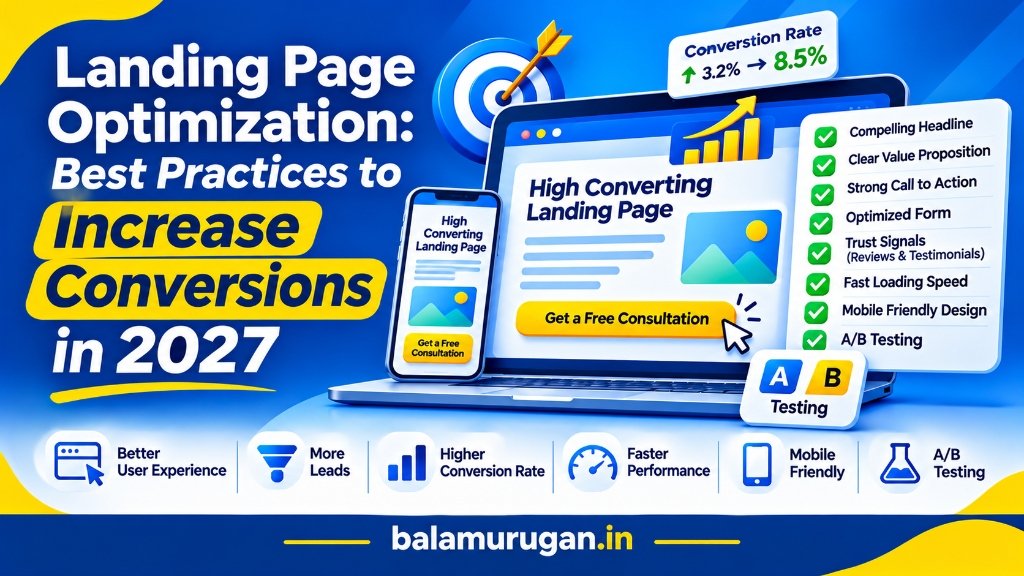
A landing page plays an important role in turning website visitors into potential customers. Whether your goal is to generate qualified leads, sell products, promote a high-ticket service, or encourage users to register, an effective landing page can help you achieve substantially better marketing results.
However, attracting visitors through SEO, Google Ads, or social media campaigns is only one part of the process. If visitors arrive at your landing page but leave without taking action, your marketing budget and traffic opportunities are largely wasted.
This is where landing page optimization becomes essential.
Landing page optimization is the disciplined process of improving a landing page's content, design, layout, loading speed, user experience, and calls to action to systematically increase conversions.
In this guide, we will explore the best landing page optimization best practices for 2027, practical conversion optimization techniques, testing methods, and ways to build high-converting landing pages that generate more enquiries and revenue.
Table of Contents
Quick Navigation- What Is Landing Page Optimization?
- Why Is Landing Page Optimization Important in 2027?
-
15 Landing Page Optimization Best Practices for 2027
- 1. Create a Clear and Compelling Headline
- 2. Add a Strong Call to Action (CTA)
- 3. Keep Your Landing Page Design Simple
- 4. Write Benefit-Focused Content
- 5. Optimize Your Lead Generation Forms
- 6. Add Customer Testimonials and Reviews
- 7. Improve Landing Page Loading Speed
- 8. Make Your Landing Page Mobile-Friendly
- 9. Match Landing Page Content With Ad Campaigns
- 10. Use High-Quality and Relevant Images
- 11. Add Trust Signals and Business Information
- 12. Use A/B Testing to Improve Performance
- 13. Reduce Unnecessary Navigation and Distractions
- 14. Use Clear and Relevant Offers
- 15. Track Conversions and Analyze User Behaviour
- How to Calculate Landing Page Conversion Rate
- Landing Page Optimization Checklist for 2027
- Best Tools for Landing Page Optimization
- Common Landing Page Optimization Mistakes to Avoid
- Frequently Asked Questions About Landing Page Optimization
- Final Thoughts
What Is Landing Page Optimization?
Landing page optimization is the process of improving individual landing page elements to encourage visitors to complete a specific action.
Unlike a broad homepage designed for general exploration, a dedicated landing page is built around one primary conversion goal, such as:
- Submitting an enquiry form
- Requesting a custom quotation
- Booking a 1-on-1 consultation
- Purchasing a product or subscription
- Registering for a software free trial
- Downloading an educational eBook or whitepaper
- Signing up for a high-value email newsletter
For example, a digital marketing agency running a Google Ads campaign for SEO services might create a dedicated landing page targeting businesses searching for enterprise SEO solutions.
The page includes a clear headline, concise service benefits, client testimonials, a streamlined lead generation form, and a prominent call to action. The goal is to make it effortless for visitors to understand the value proposition and take the next step.
Why Is Landing Page Optimization Important in 2027?
Driving traffic to your website does not automatically generate business enquiries or sales. Your landing page must deliver a convincing, friction-free experience that matches what visitors expect upon arrival.
Here are five critical benefits of landing page conversion optimization:
1. Increase Conversion Rates
An optimized landing page helps visitors understand your offer immediately and removes hurdles that prevent action. Refining headlines, forms, page hierarchy, and calls to action directly increases the percentage of visitors who convert.
2. Improve User Experience
A clean layout, readable typography, fast loading speed, and mobile-friendly design make it enjoyable for visitors to consume information and interact with your brand across all devices.
3. Generate More Quality Leads
A targeted landing page speaks directly to the needs and pain points of your ideal customer profile. This pre-qualifies visitors, ensuring that incoming leads are genuinely interested in your solutions.
4. Improve Advertising Performance
When your landing page closely aligns with your ad copy and creative, visitors experience seamless message matching. In Google Ads, a higher landing page experience directly improves your Quality Score, which lowers your cost per click (CPC) and cost per acquisition (CPA).
5. Make Better Use of Marketing Budgets
If your paid campaigns already generate steady clicks, optimizing the landing page allows you to extract significantly more revenue from your existing traffic without needing to inflate your ad budget.
15 Landing Page Optimization Best Practices for 2027
Follow these practical conversion optimization techniques to strengthen user experience and maximize your conversion rates:
1. Create a Clear and Compelling Headline
Your headline is the first element visitors evaluate when they land on your page. Within a few seconds, it must communicate what you offer and why visitors should care.
A confusing or generic headline causes visitors to bounce immediately without ever scrolling down.
Headline optimization best practices:
- Explain the primary benefit clearly and concisely.
- Mention the specific service or outcome offered.
- Use direct, natural language rather than ambiguous marketing buzzwords.
- Match the exact intent of the ad or search query that brought the visitor.
- Avoid hyperbolic or unbelievable guarantees.
Example:
- Weak headline: Welcome to Our Digital Agency
- Better headline: Generate More Qualified Leads with Data-Driven SEO & PPC Services
2. Add a Strong Call to Action (CTA)
A call to action informs visitors precisely what action to take next. Without a noticeable CTA, visitors will leave without inquiring, booking, or buying.
High-converting CTA text examples:
- Get a Free Consultation
- Request a Custom Quote
- Book a 15-Minute Strategy Call
- Start Your Free 14-Day Trial
- Claim Your Website Audit
CTA optimization tips:
- Use active verbs rather than passive labels like "Submit".
- Design buttons with high contrast colors that pop off the background.
- Position the primary CTA above the fold alongside the hero headline.
- Repeat the CTA strategically on long landing pages so users don't have to scroll back up.
- Ensure button tap targets are at least 48px tall on mobile touchscreens.
- Keep the page focused on one single primary conversion goal.
3. Keep Your Landing Page Design Simple
A cluttered layout full of competing banners, sidebars, and flashy animations distracts visitors from your core message. Your design should act as an uncluttered visual funnel leading toward the CTA.
Clean design principles:
- Use generous whitespace around key text blocks and buttons.
- Maintain a strict typographical hierarchy (H1, H2, body text).
- Organize details into bite-sized visual cards or grid modules.
- Remove global headers and secondary navigation links on dedicated PPC landing pages.
4. Write Benefit-Focused Content
Prospective customers care far more about how you solve their problems than about a dry list of technical specifications. Frame every service feature around its tangible business outcome.
Feature-focused vs. Benefit-focused comparison:
- Feature-focused: "We perform technical site audits, canonical checks, and keyword tracking."
- Benefit-focused: "Fix invisible crawling barriers, outrank competitors, and capture ready-to-buy search traffic before they visit someone else."
Use concise paragraphs, bulleted checklists, and clear subheadings so readers can grasp the value in under thirty seconds.
5. Optimize Your Lead Generation Forms
Forms are often where conversions either succeed or collapse. Requiring too much unnecessary personal data at the initial touchpoint introduces friction and drives abandonment. According to web form usability research by the Nielsen Norman Group, keeping input fields to a minimum and using clear, top-aligned labels significantly decreases cognitive friction and prevents form abandonment.
High-converting form architecture:
- Essential initial fields: Full Name, Business Email, Phone Number, Service Required.
- Use inline field validation so users receive real-time confirmation as they type.
- Label fields clearly above the input box rather than relying solely on disappearing placeholder text.
- Clearly state your privacy commitment (e.g., "We respect your privacy. No spam ever.").
- Test multi-step forms for high-involvement services to make lengthy questionnaires less daunting.
6. Add Customer Testimonials and Reviews
First-time visitors often feel cautious about contacting an unfamiliar company. Authentic social proof establishes credibility and validates your claims.
High-trust proof elements:
- Specific client testimonials: Include the client's name, company, and measured results.
- Verified review badges: Feature ratings from Google Business Profile, Clutch, or Trustpilot.
- Mini case study snapshots: Highlight the starting problem, the strategy implemented, and the percentage lift achieved.
- Client brand logos: Showcase recognized companies you've partnered with.
7. Improve Landing Page Loading Speed
Page speed directly impacts conversion rates. Research consistently demonstrates that every additional second of loading delay causes a measurable drop in conversion volume.
Speed optimization actions:
- Compress images using modern WebP or optimized JPG formats.
- Minify CSS and defer non-critical JavaScript scripts.
- Audit Core Web Vitals targets: Largest Contentful Paint (LCP) ≤ 2.5s, Interaction to Next Paint (INP) ≤ 200ms, and Cumulative Layout Shift (CLS) ≤ 0.1 according to Google's Core Web Vitals guidelines.
- Leverage browser caching and fast CDN content delivery.
- Regularly audit page speed using Google PageSpeed Insights.
8. Make Your Landing Page Mobile-Friendly
With over 60% of paid ad traffic originating on smartphones, mobile optimization is non-negotiable. Following Google's mobile-first indexing best practices, your page layout must serve identical content and maintain flawless touch responsiveness across both mobile and desktop viewports.
Mobile CRO checklist:
- Use responsive fluid layouts that fit any screen width without horizontal scrolling.
- Ensure phone numbers are clickable links (
tel:+916374191927) for instant dialing. - Use sticky mobile CTA bars so the action button remains accessible while scrolling.
- Test form inputs on actual iOS and Android devices to ensure proper keyboard layouts appear.
9. Match Landing Page Content With Ad Campaigns
Message matching is the alignment between your ad copy and your landing page experience. If your ad promises "50% Off Dental Implants", but the landing page opens with a generic clinic overview, visitors feel disoriented and leave. Google explicitly evaluates this relevance via its Quality Score algorithm; explore official guidelines in the Google Ads Landing Page Experience documentation.
Message match best practices:
- Echo the exact headline or value proposition from your Google or Meta ad.
- Maintain visual continuity with matching color palettes and imagery.
- Ensure the advertised special offer is immediately visible above the fold.
10. Use High-Quality and Relevant Images
Generic stock photos of people shaking hands in generic office buildings erode trust. Use authentic imagery that helps the visitor visualize your service or product in action.
Recommended visual assets:
- Real photos of your team, office, or client workshops.
- High-resolution software interface screenshots or product mockups.
- Before-and-after project comparisons and transformation visuals.
- Descriptive infographics summarizing complex service workflows.
11. Add Trust Signals and Business Information
Prospects need to know that your business is legitimate, dependable, and easily reachable.
Essential trust signals:
- Physical office address and verified contact numbers.
- Industry certifications, partner badges (e.g., Google Partner, Meta Certified), and awards.
- Clear links to your Privacy Policy and Terms of Service.
- SSL encryption badges and secure transaction guarantees for e-commerce checkouts.
12. Use A/B Testing to Improve Performance
Never rely solely on intuition when deciding what converts best. Split testing (A/B testing) compares two variations of a page against each other to identify which version statistically drives more leads. Leading experimentation frameworks from Optimizely recommend running tests until achieving at least 95% statistical confidence to validate winners.
High-impact elements to split test:
- Headlines: Test benefit-driven headlines against problem-focused or question-based headlines.
- CTA button copy: Test "Request a Free Consultation" against "Speak With an SEO Expert".
- Form length: Compare a short 3-field form against a 5-field pre-qualifying form.
- Hero visuals: Test product screenshot mockups against authentic human photographs.
13. Reduce Unnecessary Navigation and Distractions
Every additional link on a paid landing page represents an exit ramp away from your primary conversion goal. For targeted ad campaigns, remove the standard website menu, footer link directories, and external blog links.
Provide just enough context for users to make an informed decision without wandering off to unrelated pages.
14. Use Clear and Relevant Offers
Your offer must provide compelling value in exchange for the visitor's contact information or payment.
| Business Type | High-Converting Landing Page Offer |
|---|---|
| Digital Marketing Agency | Free Website & SEO Audit Consultation |
| Healthcare & Dental Clinic | Same-Day Appointment Booking with Free First Checkup |
| SaaS Software Company | 14-Day Full-Access Free Trial (No Credit Card Required) |
| B2B Industrial & Printing | Instant Project Cost Estimate & Free Sample Kit |
| Financial & Tax Consultancy | Confidential Tax Saving Strategy Consultation |
| E-Commerce Store | First-Order Discount with Free Priority Shipping |
15. Track Conversions and Analyze User Behaviour
Effective landing page optimization relies on concrete behavioral analytics rather than speculation. Set up accurate event tracking with Google Analytics 4 and Google Tag Manager according to the official Google Analytics event measurement protocol.
| Metric | What It Measures |
|---|---|
| Conversion Rate | Percentage of visitors who complete your primary desired action |
| Bounce Rate | Percentage of unengaged single-page sessions in GA4 |
| Form Submissions | Total volume of completed, qualified lead generation submissions |
| CTA Clicks | Total interactions on key call to action and phone click buttons |
| Average Engagement Time | Time users actively interact with page content before acting |
| Cost Per Lead (CPL) | Total ad spend divided by confirmed leads acquired |
How to Calculate Landing Page Conversion Rate
The landing page conversion rate measures the efficiency with which your page turns visitors into active inquiries or customers.
Standard Conversion Rate Formula:
Conversion Rate = (Total Number of Conversions ÷ Total Number of Visitors) × 100
Practical Example:
Suppose your paid Google Ads campaign directs 2,000 visitors to your landing page in one month, resulting in 100 completed enquiry forms:
Conversion Rate = (100 ÷ 2,000) × 100- Conversion Rate = 5%
If you optimize your headline, simplify your form fields, and improve page speed to lift that conversion rate from 5% to 8%, you generate 160 leads from the exact same 2,000 visitors—a 60% increase in leads without spending a single extra rupee or dollar on advertising.
Landing Page Optimization Checklist for 2027
Before launching or auditing any landing page, verify that every item below is fulfilled:
| Category | Verification Item |
|---|---|
| Headline & Value | Clear, benefit-focused headline matching advertising intent |
| Offer | Specific, valuable proposition with transparent terms |
| Call to Action | Contrasting CTA button with active verb phrasing above and below fold |
| Layout & Design | Clean, distraction-free visual hierarchy without unnecessary exit links |
| Lead Form | Minimal essential fields with mobile validation and privacy commitment |
| Trust & Proof | Authentic customer testimonials, client logos, and verified review badges |
| Visuals & Media | High-res screenshots and photos compressed in modern WebP format |
| Speed & Vitals | Sub-2.5 second LCP load time audited in PageSpeed Insights |
| Mobile Usability | Tested tap targets, readable font sizes, and click-to-call phone links |
| Tracking & GA4 | GTM conversion triggers firing accurately on form completion |
Best Tools for Landing Page Optimization
Equip your optimization toolkit with these proven industry tools:
| Tool | Main Purpose |
|---|---|
| Google Analytics 4 | Traffic attribution, session duration, and conversion event monitoring |
| Google Tag Manager | Custom event tracking for form submissions, CTA clicks, and video plays |
| Google PageSpeed Insights | Diagnosing Core Web Vitals speed barriers and asset bloat |
| Microsoft Clarity | Free heatmap tracking, scroll maps, and session replay recordings |
| Hotjar | User behavior heatmaps, drop-off analysis, and feedback surveys |
| VWO (Visual Website Optimizer) | Full-scale multivariate and A/B split experimentation |
| Unbounce | Rapid dedicated landing page creation and automated smart traffic routing |
| Google Search Console | Monitoring organic landing page search queries and click-through rates |
Common Landing Page Optimization Mistakes to Avoid
Even carefully constructed pages can underperform if basic CRO principles are overlooked. Eliminate these common pitfalls:
- Using a Generic Headline: A vague headline fails to convey your unique value proposition. Specify your exact offering immediately.
- Adding Too Many Form Fields: Extensive forms increase cognitive load. Request only essential qualification data upfront.
- Ignoring Mobile Visitors: Designing for desktop while neglecting touchscreens forfeits the majority of paid advertising traffic.
- Deploying Multiple Competing CTAs: Offering too many conflicting actions (e.g., download, call, buy, subscribe) causes decision paralysis.
- Slow Page Speed: Heavy uncompressed hero images and script bloat drive users away before your headline even renders.
- Failing to Configure Conversion Tracking: Operating without verified GA4 and GTM goals blinds you to true acquisition costs and campaign ROI.
- Publishing Unverified Claims: Fabricated awards, fake reviews, or exaggerated guarantees damage brand credibility permanently.
- Stopping After One A/B Test: CRO is an iterative cycle. Ongoing testing uncovers incremental compound gains over time.
Key Takeaways
Landing page optimization is the highest-leverage marketing activity for transforming traffic into dependable business revenue.
- Laser-Focused Purpose: Dedicate each landing page to a single conversion goal supported by an undeniable value proposition.
- Frictionless User Journey: Combine sub-2.5 second loading speeds, mobile-first layouts, and minimal form fields.
- Seamless Message Match: Maintain absolute consistency between your advertising creative and the landing page experience.
- Evidence-Based Experimentation: Base design decisions on session recordings, heatmaps, and statistically valid A/B split testing.
Frequently Asked Questions About Landing Page Optimization
Landing page optimization is the process of improving a landing page's design, content, user experience, loading speed, and calls to action to increase conversions such as enquiries, registrations, and sales.
Start by understanding your audience and conversion goal. Then improve the headline, offer, page content, CTA, form, images, mobile experience, and loading speed. Track performance and test changes regularly.
A clear headline, relevant offer, benefit-focused content, simple form, strong CTA, genuine trust signals, and smooth mobile experience can help a landing page convert better.
Analyze visitor behaviour, identify areas where users leave, simplify forms, improve CTA wording, match content with advertising messages, and run structured A/B tests.
Important techniques include headline optimization, CTA improvement, form optimization, mobile-friendly design, page speed improvements, trust signals, message matching, and conversion tracking.
Test when you have a clear improvement hypothesis and enough traffic to evaluate the results. The required testing period depends on traffic volume, conversion rates, and the size of the expected improvement. Avoid ending tests too early or repeatedly checking results and stopping when they temporarily look favourable.
There is no single conversion rate that is ideal for every business. Performance depends on industry, traffic source, offer, audience, pricing, and conversion goal. Compare your results with your own historical performance and relevant industry benchmarks.
Yes. Landing page optimization improves content relevance, user experience, mobile usability, and loading performance. Aligning these factors with Google's helpful content guidelines helps search engines understand your page's authority, index content faster, and reward high-quality user engagement.
Final Thoughts
Landing page optimization is an ongoing discipline that connects design, persuasive copywriting, user psychology, site speed, and analytics.
A high-converting landing page clearly answers what you offer, why it matters, who it is for, and how to take action without hesitation.
Start with a compelling headline, a benefit-driven value proposition, and a streamlined form. Then monitor heatmaps and conversion metrics to run structured A/B tests that scale your results.
By implementing these landing page optimization best practices for 2027, businesses can maximize the return on every marketing dollar, generate higher-quality leads, and build sustainable online growth.

Disclaimer: The strategies, insights, and recommendations shared across this article are for general informational and educational purposes only. Digital marketing, search engine optimization (SEO), Google algorithms, and paid advertising platform policies evolve continuously. Actual performance and results may vary based on domain authority, website age, industry competition, technical infrastructure, and execution. Always test changes in a controlled environment and consult official platform guidelines before making major business decisions. Mention of third-party tools, platforms, or resources does not constitute an endorsement or guarantee of results.