Table of Contents
- Introduction
- What Is On-Page SEO?
- Why On-Page SEO Matters
-
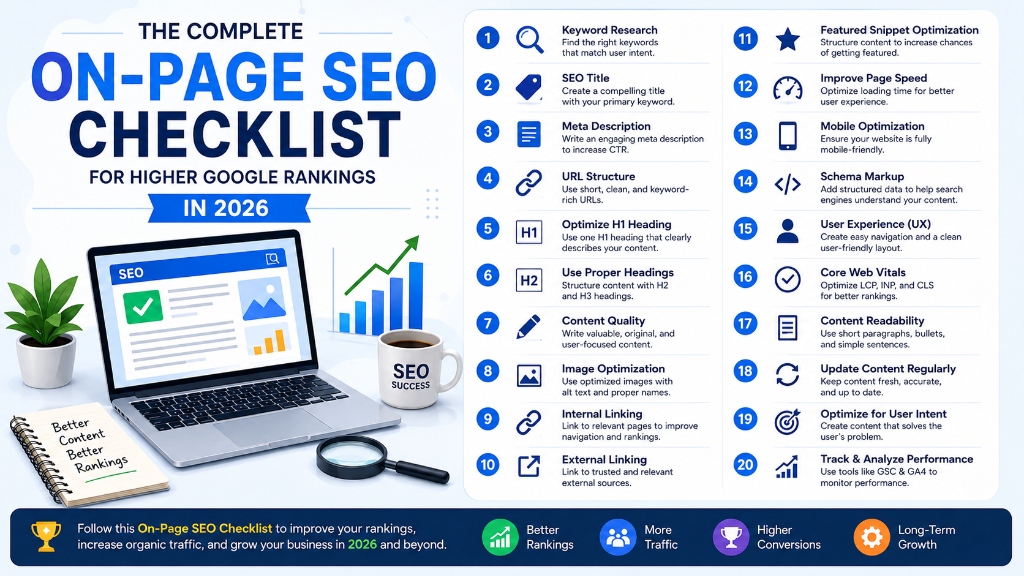
Complete On-Page SEO Checklist
- 1. Perform Keyword Research
- 2. Optimize the SEO Title
- 3. Write an Effective Meta Description
- 4. Use an SEO-Friendly URL
- 5. Optimize the H1 Heading
- 6. Structure Content Using H2 and H3 Headings
- 7. Place Keywords Naturally
- 8. Write High-Quality Content
- 9. Optimize Images
- 10. Improve Content Readability
- 11. Build a Strong Internal Linking Structure
- 12. Link to Trusted External Sources
- 13. Optimize for Featured Snippets
- 14. Improve Core Web Vitals
- 15. Make Your Website Mobile Friendly
- 16. Add Schema Markup
- 17. Optimize Images for Better SEO
- 18. Optimize for AI Search
- 19. Improve User Experience
- 20. Keep Content Fresh
- Common On-Page SEO Mistakes
- On-Page SEO Checklist Summary
- Future of On-Page SEO
- Conclusion
Introduction
On-page SEO remains one of the most important factors for achieving higher Google rankings in 2026. While search engines have become more advanced with artificial intelligence, machine learning, and user intent analysis, the fundamentals of optimizing individual web pages continue to play a significant role in organic search success.
Many website owners focus on publishing content without properly optimizing it for search engines or users. Even well-written articles may struggle to rank if essential on-page SEO elements are missing. From keyword placement and heading structure to internal linking and page speed, every detail contributes to how search engines understand and rank your content.
Modern on-page SEO is no longer about inserting keywords repeatedly. Instead, it focuses on delivering valuable, well-structured, and user-friendly content that satisfies search intent while providing an excellent browsing experience.
This comprehensive guide covers the most important on-page SEO factors you should optimize to improve your Google rankings, attract qualified visitors, and build long-term organic growth.
What Is On-Page SEO?
On-page SEO refers to the process of optimizing individual web pages to improve their visibility in search engine results. It involves optimizing both the content and HTML elements of a page so search engines can better understand its topic and relevance.
Unlike off-page SEO, which focuses on backlinks and external signals, on-page SEO is completely under your control.
Common on-page SEO elements include:
- Keyword optimization
- Title tags
- Meta descriptions
- Heading structure
- Content quality
- Internal linking
- Image optimization
- URL structure
- User experience
- Page speed
When these elements work together, your website becomes easier for search engines to crawl and more valuable for users.
Why On-Page SEO Matters
Proper on-page optimization offers several benefits:
- Higher Google Rankings: Well-optimized pages have a better chance of appearing on the first page of search results.
- Better User Experience: Clear content structure, fast loading pages, and mobile-friendly layouts improve visitor engagement.
- Increased Organic Traffic: Higher rankings typically lead to more clicks and qualified visitors.
- Improved Conversion Rates: Helpful content encourages users to take action, whether that's contacting your business or making a purchase.
- Stronger Topical Authority: Consistently publishing optimized content helps establish your website as an authority within your niche.
Complete On-Page SEO Checklist
Below are the essential elements every page should include before publication.
1. Perform Keyword Research
Every successful SEO strategy begins with proper keyword research. Choose one primary keyword and several related keywords that match the user's search intent.
Instead of targeting only high-volume keywords, focus on long-tail, question-based, low-competition, local, and semantic keywords.
Example:
- Primary Keyword: On-Page SEO Checklist
- Secondary Keywords: On-Page SEO Guide, SEO Optimization Tips, Google Ranking Checklist, SEO Best Practices, Website Optimization
2. Optimize the SEO Title
Your SEO title is one of the first elements users notice in search results. Include your primary keyword and keep the title between 50–60 characters to avoid truncation.
Good Example: Complete On-Page SEO Checklist for Higher Google Rankings in 2026
3. Write an Effective Meta Description
Although meta descriptions are not a direct ranking factor, they significantly influence click-through rates. Keep it between 150–160 characters, include your primary keyword, and add a clear call to action.
Example: Learn the complete on-page SEO checklist for 2026 and discover practical optimization techniques to improve Google rankings and organic traffic.
4. Use an SEO-Friendly URL
URLs should be clean, lowercase, hyphen-separated, and descriptive. Avoid numbers and query parameters.
- Good URL: yourwebsite.com/on-page-seo-checklist
- Poor URL: yourwebsite.com/post?id=25794
5. Optimize the H1 Heading
Each page should contain only one H1 heading that naturally includes the primary keyword.
Example: The Complete On-Page SEO Checklist for Higher Google Rankings in 2026
6. Structure Content Using H2 and H3 Headings
Proper heading hierarchy improves readability. Use H2 headings for main topics and H3 tags for supporting sections.
7. Place Keywords Naturally
Avoid keyword stuffing. Write conversationally and place keywords naturally in the introduction, body paragraphs, and headings. Modern search engines rely on semantic understanding and user context rather than keyword repetition.
8. Write High-Quality Content
Content quality remains the most important ranking factor. Make sure your articles are comprehensive, accurate, experience-driven, and easy to read.
9. Optimize Images
Compress image file sizes, use WebP formats, add descriptive filenames, and write keyword-rich alt text.
- Image File Name: on-page-seo-checklist-2026.webp
- Alt Text: Complete On-Page SEO Checklist for Higher Google Rankings in 2026
10. Improve Content Readability
Use short paragraphs, bullet points, lists, simple sentence structures, and tables to help users scan your content easily.
11. Build a Strong Internal Linking Structure
Internal links connect your content contextually, distributing page authority and helping Google crawl your website more efficiently. Link to related guides such as your Technical SEO Guide, Keyword Research Guide, or Local SEO Checklist.
12. Link to Trusted External Sources
Reference authoritative external sources like Google Search Central or PageSpeed Insights to improve your website's trust and credibility.
13. Optimize for Featured Snippets
Answer questions directly near the top of headings, add bulleted lists, and include comparison tables. For example: On-page SEO is the process of optimizing individual web pages to improve their visibility in search engines and provide a better user experience.
14. Improve Core Web Vitals
Google evaluates visual stability and loading speed. Optimize Largest Contentful Paint (LCP) to be under 2.5 seconds, Interaction to Next Paint (INP) to be under 200 milliseconds, and Cumulative Layout Shift (CLS) to be under 0.1.
15. Make Your Website Mobile Friendly
Google uses mobile-first indexing. Make sure your website is fully responsive, loads fast, and utilizes readable typography on mobile viewports.
16. Add Schema Markup
Implement structured data like Article, FAQ, and Breadcrumb Schema to qualify for rich snippets in Google search result pages.
17. Optimize Images for Better SEO
Ensure that images do not drag down your page speeds. Enable lazy loading, specify dimensions to prevent layout shifts, and compress all image assets.
18. Optimize for AI Search
To improve rankings in generative search boxes, cover topics comprehensively, use clear Q&A formats, and answer specific user intents directly.
19. Improve User Experience
A simple navigation structure, fast loading times, and clean layouts keep visitors engaged and reduce bounce rates.
20. Keep Content Fresh
Review and update your important pages every few months by refreshing statistics, fixing broken links, and adding new insights.
Common On-Page SEO Mistakes
Many websites fail to achieve first-page rankings due to avoidable errors:
- Keyword Stuffing: Repeating keywords excessively.
- Duplicate Content: Not writing original content.
- Multiple H1 Tags: Using more than one H1 heading.
- Slow Speeds: Uncompressed assets and bloated scripts.
- Broken Links: Outdated internal or external references.
On-Page SEO Checklist Summary
- Targeted one primary keyword
- Added related keywords naturally
- Written a compelling SEO title
- Created an engaging meta description
- Used an SEO-friendly URL
- Added one H1 heading
- Organized content with H2 and H3 headings
- Published original, valuable content
- Optimized images and alt text
- Added internal links
- Included trusted external references
- Optimized Core Web Vitals
- Ensured mobile responsiveness
- Added schema markup
- Updated the content for accuracy
Future of On-Page SEO
As search engines evolve with machine learning, modern SEO focuses on creating helpful, people-first content. Prioritizing technical excellence, topical authority, and continuous optimization will ensure your pages remain competitive in both traditional and AI-powered search results.
Frequently Asked Questions
On-Page SEO is the process of optimizing individual web pages to improve their visibility in search engines. It includes optimizing content, title tags, meta descriptions, URLs, headings, images, internal links, and user experience to help search engines understand your page and rank it higher.
On-Page SEO helps search engines understand your content while improving the user experience. A properly optimized page can achieve better rankings, attract more organic traffic, increase click-through rates, and generate higher conversions.
You should review and update important pages every 3 to 6 months. Refresh outdated information, improve content quality, optimize keywords, update internal links, and ensure your page aligns with the latest Google ranking factors.
Some of the most important factors include: high-quality content, keyword optimization, SEO-friendly title tags, meta descriptions, heading structure (H1, H2, H3), internal linking, image optimization, mobile responsiveness, Core Web Vitals, page speed, and schema markup.
Yes. AI-powered search engines prioritize well-structured, high-quality, and user-focused content. Optimizing headings, answering user questions, improving readability, and using structured data can improve your visibility in AI-generated search results.
On-Page SEO focuses on optimizing elements within your website, such as content, titles, images, and technical improvements. Off-Page SEO focuses on external factors like backlinks, brand mentions, social signals, and online authority that help improve your website's credibility.
Final On-Page SEO Checklist
- Targeted one primary keyword
- Added relevant secondary keywords naturally
- Written an SEO-friendly title
- Optimized the meta description
- Used a clean and descriptive URL
- Added one H1 heading
- Used proper H2 and H3 headings
- Published original, high-quality content
- Optimized all images and alt text
- Added internal links
- Linked to trusted external sources
- Improved page speed
- Optimized for mobile devices
- Implemented schema markup
- Checked Core Web Vitals
- Added a clear call to action
Conclusion
On-Page SEO is one of the most effective ways to improve your website's visibility and achieve long-term success in search engines. While Google's algorithms continue to evolve with artificial intelligence, the core principles of creating valuable, user-focused content remain unchanged.
A well-optimized page combines quality content, keyword relevance, technical optimization, fast loading speed, mobile responsiveness, structured data, and a seamless user experience. These elements work together to help search engines understand your content and provide users with the best possible answers to their queries.
Rather than focusing only on rankings, aim to create pages that genuinely help your audience. By following this complete On-Page SEO checklist, you'll build a stronger website, improve organic traffic, and stay competitive in both traditional and AI-powered search results throughout 2026 and beyond.