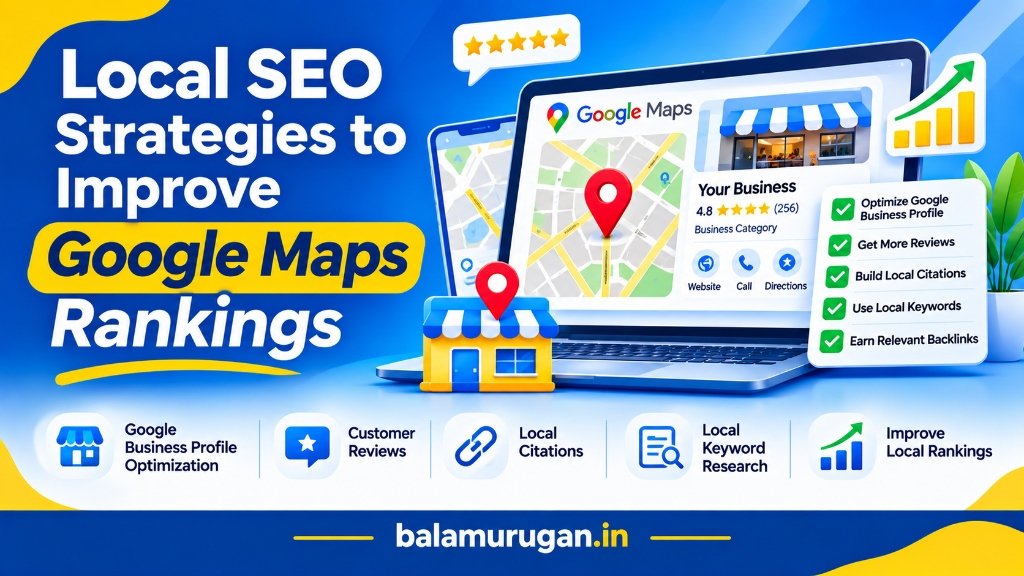
When people search for products or services near them, Google Maps often becomes one of the first places they look. Whether someone needs a dentist, restaurant, printing company, plumber, or digital marketing consultant, they usually want to find a reliable business in their immediate geographic area.
For local businesses, appearing prominently on Google Maps can create valuable opportunities to attract nearby customers, generate direct phone calls, increase website visits, and drive consistent qualified enquiries.
However, simply creating a Google Business Profile does not guarantee top visibility. Businesses require a consistent local SEO strategy that improves their online presence, builds credibility, and helps Google accurately understand their services and service areas.
In this comprehensive guide, you will learn practical local SEO strategies to improve Google Maps rankings, optimize your Google Business Profile, strengthen local relevance, and attract more customers from your target market.
Table of Contents
Quick Navigation- What Is Local SEO?
- How Does Google Maps Ranking Work?
-
12 Effective Local SEO Strategies to Improve Google Maps Rankings
- 1. Optimize Google Business Profile
- 2. Choose Right Categories
- 3. Conduct Local Keyword Research
- 4. Optimize Website for Local SEO
- 5. Maintain NAP Consistency
- 6. Get Genuine Customer Reviews
- 7. Upload High-Quality Photos
- 8. Build Local Citations
- 9. Build Local Backlinks
- 10. Publish Local Blog Content
- 11. Add LocalBusiness Schema
- 12. Monitor Performance Regularly
- Google Maps SEO Checklist for Local Businesses
- Common Local SEO Mistakes to Avoid
- How Long Does It Take to Improve Google Maps Rankings?
- Frequently Asked Questions About Local SEO
- Final Thoughts
What Is Local SEO?
Local SEO is the specialized process of optimizing a business's online presence to improve its visibility in location-based search results and the Google Maps Local 3-Pack.
For example, when consumers search for queries with geographic intent such as:
- Dentist in Chennai
- Best printing company near me
- Digital marketing consultant in Madurai
- Plumber in Anna Nagar
- Tax consultant in Milpitas
Google evaluates user intent and presents a map pack displaying the top 3 local businesses alongside their star ratings, reviews, street address, operating hours, phone number, and driving directions.
Local SEO empowers companies to capture these high-intent local searches by systematically aligning their Google Business Profile, website landing pages, directory citations, user reviews, and regional authority signals.
How Does Google Maps Ranking Work?
According to Google's official local ranking documentation, local search results are calculated primarily through three core pillars:
1. Relevance
Relevance gauges how accurately a local business profile matches what a person is searching for. If someone searches for an "emergency pediatric dentist," Google algorithmically scans profiles for business categories, listed medical services, and detailed descriptions that correspond directly with that query.
How to maximize relevance:
- Select the most precise primary business category available.
- Add accurate secondary categories that reflect supporting services.
- Itemize your entire catalogue of products and services.
- Craft a detailed, informative business description.
- Incorporate local keywords naturally into your website landing pages.
2. Distance
Distance measures how close a prospective business is from the location term stated in the search query (or the searcher's physical GPS coordinates if no city name is provided). For example, someone searching for a dentist near T. Nagar will see different local map results compared to someone searching from Velachery.
While a business cannot alter a user's real-time physical location, you can ensure your physical address pin is accurately placed and your defined service areas reflect the regions you actively serve.
3. Prominence
Prominence measures how well-established, authoritative, and reputable a business appears both online and offline. Prominence factors include review velocity, aggregate star ratings, directory citations, quality backlinks, and article mentions across the regional web.
How to build prominence:
- Consistently generate genuine positive customer reviews.
- Earn authoritative editorial backlinks from local organizations and chambers.
- Maintain strict NAP (Name, Address, Phone) consistency across directories.
- Publish helpful, localized content that answers regional consumer questions.
These three ranking factors operate in tandem—no single optimization alone guarantees a top 3 position on Google Maps.
12 Effective Local SEO Strategies to Improve Google Maps Rankings
1. Optimize Your Google Business Profile
Your Google Business Profile (formerly Google My Business) is the anchor of your entire local SEO campaign. An incomplete, unverified, or outdated profile creates friction for customers and weakens Google's confidence in your business data.
Core Google Business Profile optimization tasks:
- Business Name: Use your real-world, registered business name without artificial keyword stuffing.
- Categories: Select the most relevant primary category and supporting secondary categories.
- Address & Service Areas: Ensure your physical location or service-area radius is clearly defined.
- Phone & Website: Add your local phone number and link directly to your primary website or location page.
- Operating Hours: Keep regular opening hours and holiday closures updated.
- Products & Services: Detail your exact service offerings with pricing and descriptions.
- Description: Write a comprehensive, 750-character profile description highlighting your expertise, values, and location.
- Photos: Upload high-resolution interior, exterior, team, and service photos regularly.
For more detailed step-by-step tactics, explore our dedicated guide on Google Business Profile Optimization Tips.
2. Choose the Right Primary and Secondary Categories
Your primary category carries the heaviest weight in Google's local relevance algorithm. Choosing an imprecise or generic category can drastically reduce your visibility for lucrative local searches.
| Business Model | Optimal Primary Category | Recommended Secondary Categories |
|---|---|---|
| Dental Clinic | Dentist | Cosmetic Dentist, Pediatric Dentist, Dental Clinic |
| Commercial Printing Firm | Commercial Printer | Print Shop, Digital Printing Service, Banner Store |
| Accounting & Tax Practice | Tax Consultant | Accountant, Bookkeeping Service, Certified Public Accountant |
| Digital Marketing Agency | Marketing Agency | Internet Marketing Service, Advertising Agency, Website Designer |
| Plumbing Contractor | Plumber | Drainage Service, Heating Contractor, Emergency Plumbing Service |
Pro Tip: Study the primary categories selected by the top 3 ranking competitors in your city, but only adopt categories that truthfully represent services your business actively delivers.
3. Conduct Local Keyword Research
Local keyword research identifies the exact phrases prospects search when seeking local solutions. Rather than targeting national or global terms, focus on service + geo combinations and conversational "near me" queries.
| Broad Generic Query | Targeted Local Search Query | Searcher Intent |
|---|---|---|
| Dental clinic | Dental clinic in Chennai | High-intent local healthcare booking |
| Printing services | Printing services in Chennai | Commercial business ordering inquiry |
| SEO services | SEO freelancer in Chennai | Direct local consulting consultation |
| Tax consultant | Tax consultant in Milpitas | Regional accounting and compliance support |
| Plumbing repairs | Plumber in Anna Nagar | Immediate emergency household dispatch |
Discover localized search queries using Google Autocomplete, Google Search Console query reports, and our framework for How to Find Low Competition Keywords for SEO.
4. Optimize Your Website for Local SEO
A Google Business Profile relies heavily on the organic authority of the website it links to. If your website is slow, disorganized, or devoid of localized signals, your Maps rankings will stagnate.
Essential on-page local SEO checklist:
- Incorporate your primary city and core service in the HTML
<title>and meta description. - Feature your exact business name, physical street address, and phone number in the site footer.
- Structure landing pages with descriptive H1 and H2 headings featuring localized keywords.
- Build dedicated service pages for each specialized offering rather than bundling everything into one generic page.
- Embed an interactive, responsive Google Map on your Contact page.
- Ensure fast mobile loading speed and compliance with technical SEO audit standards.
5. Maintain NAP Consistency Across Online Directories
NAP consistency refers to keeping your business Name, Address, and Phone Number 100% identical everywhere it appears online. Inconsistent phone numbers or variations in address formatting (e.g., "Suite 200" vs "Unit 2B") create ambiguity for search engine crawlers and degrade ranking confidence.
NAP audit checklist:
- Standardize your company name across your website, Google profile, social media, and local citations.
- Use a single local telephone area code number instead of toll-free 1-800 numbers where possible.
- Regularly search for and merge duplicate directory profiles or unclaimed legacy listings.
- Update your information immediately across all platforms whenever you relocate offices or change contact numbers.
6. Get More Genuine Google Customer Reviews
Customer reviews directly influence Google's prominence ranking factor while serving as social proof for prospective buyers. Profiles with steady review velocity and high star ratings consistently capture higher click-through rates.
Effective review acquisition tactics:
- Generate your short Google review URL from your profile dashboard and share it in follow-up emails and WhatsApp messages.
- Print review QR codes on invoices, business cards, reception desks, and packaging.
- Train customer service personnel to ask satisfied clients for feedback immediately after delivering a successful service.
- Respond to every review promptly—thank positive reviewers and address negative feedback with professionalism and solutions.
Warning: Never purchase fake reviews or incentivize customers with discounts or gifts. Google's spam filters aggressively detect review fraud and will suspend non-compliant profiles.
7. Upload High-Quality Business Photos
Google Maps users heavily favor profiles with authentic photography. Profiles featuring regular photo uploads receive significantly more direction requests and website clicks than profiles with static stock imagery.
Recommended photo categories:
- Exterior Photos: Clear street view angles showing your storefront signage so visitors recognize your location easily.
- Interior Photos: Well-lit shots of your lobby, conference rooms, workstations, or treatment areas.
- Team Photos: Professional photos of your leadership and customer-facing staff to build trust.
- Equipment & Work: Real action shots of machines, project installations, or completed work.
8. Build Relevant Local Citations
A citation is any online mention of your business NAP details on web directories, business portals, or review sites. High-quality citations corroborate your location and establish authority.
High-priority citation platforms:
- Major national data aggregators and business platforms (Justdial, IndiaMART, Sulekha, YellowPages, Yelp).
- Local Chambers of Commerce and regional merchant associations.
- Niche industry portals (e.g., Practo for doctors, Clutch for digital agencies).
- Verified social profiles (LinkedIn Company Page, Facebook Business, Instagram).
Focus on authoritative, industry-specific platforms rather than spamming hundreds of low-tier directory submission websites.
9. Build High-Quality Local Backlinks
Backlinks from websites rooted in your geographic community pass immense local equity to your domain. A link from a respected local news outlet or college is often more influential for Google Maps rankings than generic national links.
Proven local link acquisition strategies:
- Sponsor local youth sports teams, charity runs, or non-profit community drives that maintain sponsor listing pages.
- Join and get featured on your local Chamber of Commerce member directory.
- Provide expert commentary or quotes on regional business trends to local journalists and newspapers.
- Partner with complementary, non-competing neighborhood businesses for co-marketing events and cross-promotional guides.
10. Publish Location-Based Blog Content
Publishing localized blog content establishes your website as a regional authority while capturing informational queries that lead into your sales funnel.
Examples of localized editorial topics:
- How to Choose the Best Commercial Printing Company in Chennai
- Common Dental Care Mistakes and When to Visit a Dentist in Anna Nagar
- Complete Local SEO Checklist for Small Businesses in Madurai
- What to Consider Before Hiring a Tax Consultant in Milpitas
Link these blog guides internally to your core service pages using descriptive anchor text as recommended in our Internal Linking Strategies Guide.
11. Add LocalBusiness Schema Markup
Schema markup structured data translates your website information into structured code that search engine algorithms understand unambiguously.
Implement LocalBusiness (or specific subtypes like Dentist, LegalService, or ProfessionalService) structured data in JSON-LD format containing:
- Official legal business name
- Street address, postal code, and country
- Exact GPS geo-coordinates (latitude and longitude)
- Primary phone number and contact email
- Official website URL and logo
- Weekly operating hours and accepted payment methods
Always validate your code with Google's Rich Results Test to verify flawless syntax.
12. Monitor Google Business Profile and Website Performance
Local search visibility is dynamic. Regular tracking allows you to detect competitor shifts, profile issues, and trending queries before they impact revenue.
| Performance Metric | What It Measures & Why It Matters |
|---|---|
| Search Impressions | How frequently your business profile appeared in Google Search and Maps queries. |
| Search Queries | The exact terms users typed to discover your listing (direct vs discovery searches). |
| Website Clicks | Referral traffic flowing directly from your Google Maps profile to your landing pages. |
| Phone Calls | Direct phone inquiries initiated through the call button on mobile Google Maps. |
| Direction Requests | Navigation prompts requesting driving or walking directions to your store or office. |
| Local Organic Positions | Keyword ranking tracking across Google Search Console and local rank tracking tools. |
Google Maps SEO Checklist for Local Businesses
Use this actionable checklist to audit your local search presence across all foundational elements:
- Profile Ownership: Claim and complete Google Business Profile verification.
- Data Accuracy: Verify that business name, physical address, and phone number match real-world signage.
- Category Alignment: Confirm that primary category represents your main revenue driver.
- Service Catalog: Populate all individual services with clear descriptions.
- Hours Accuracy: Review regular opening hours and set holiday schedules in advance.
- On-Page Signals: Optimize website title tags, headers, and footer address blocks.
- NAP Directory Consistency: Clean up duplicate listings and inconsistent directory records.
- Review Engine: Establish an automated follow-up system to request authentic reviews.
- Review Responses: Respond to 100% of reviews with helpful, keyword-aware replies.
- Photo Cadence: Upload new interior, exterior, and team photos at least twice per month.
- Structured Data: Implement and validate JSON-LD
LocalBusinessschema. - Performance Reviews: Audit monthly Google Business Profile insights and Search Console clicks.
Common Local SEO Mistakes to Avoid
Avoid these critical missteps that can trigger Google algorithmic penalties or profile suspensions:
- Keyword stuffing the business name: Adding fake keywords or city names (e.g., "Acme Dental - Best Cheap Dentist Chennai") violates Google guidelines and invites account suspension.
- Selecting inaccurate categories: Picking unrelated categories in hopes of gaining extra traffic confuses Google's relevance engine.
- Ignoring customer reviews: Leaving reviews unanswered signals poor customer engagement to both prospects and search crawlers.
- Using a P.O. Box or virtual office address: Google requires genuine physical addresses with in-person customer contact during stated business hours.
- Letting business details go stale: Failing to update holiday hours or phone numbers creates negative customer experiences.
- Creating duplicate profiles: Spawning multiple profiles for the same physical location splits review authority and damages rankings.
- Buying low-quality links or fake reviews: Algorithmic spam detection systems will flag inorganic review bursts and penalize profile prominence.
How Long Does It Take to Improve Google Maps Rankings?
There is no instantaneous timeline for Google Maps optimization. Depending on local market competition, previous profile health, and physical distance from searchers, businesses typically observe results across three phases:
- Weeks 1–4: Profile verification, primary category correction, and photo updates can produce immediate increases in search impressions and profile completeness scores.
- Months 2–3: Ongoing review generation, on-page optimization, and NAP cleanup begin lifting the profile into the competitive local top 10 rankings.
- Months 4–6+: Consistent review velocity, localized link building, and topical content clustering help secure and maintain positions within the coveted Google Maps Local 3-Pack.
Frequently Asked Questions About Local SEO
Optimize your Google Business Profile, select relevant categories, maintain accurate business information, generate genuine customer reviews, improve your website's local SEO, and earn relevant local backlinks.
Yes. Google Business Profile helps businesses manage how their information appears on Google Search and Maps. A complete and accurate profile makes it easier for potential customers to understand and contact your business.
There is no fixed number of reviews required to rank higher on Google Maps. Focus on receiving genuine customer feedback consistently and responding professionally.
Relevant backlinks can contribute to your website's authority and overall online prominence. However, no particular backlink guarantees improved Google Maps positions.
Accurate local citations help customers find consistent business information across the web. Prioritize trusted, relevant directories rather than focusing only on citation quantity.
Yes. A business can have a Google Business Profile without a website, provided it meets Google's eligibility requirements. However, a useful website can provide additional information and support broader local search visibility.
Local SEO is a broader process of improving visibility for location-based searches across search engines and online platforms. Google Maps SEO focuses more specifically on improving a business's presence in Google Maps results.
Update your profile whenever important business information changes. Regularly review opening hours, services, contact details, photos, and customer reviews to keep the information accurate.
Key Takeaways
Achieving top Google Maps visibility requires a balanced execution of relevance, distance, and prominence signals rather than shortcut tactics.
- Claim & Complete Your Profile: Complete 100% of profile fields with accurate business hours, categories, services, and photos.
- Maintain Absolute NAP Consistency: Ensure your Name, Address, and Phone number are identical across your website, citations, and directories.
- Prioritize Review Velocity: Systematically request genuine customer reviews and provide helpful, professional responses to all feedback.
- Build Localized Authority: Pair your Google profile with a fast, mobile-optimized website featuring local schema and neighborhood backlink equity.
Final Thoughts
Improving Google Maps rankings requires more than creating a basic Google Business Profile. Businesses require a disciplined, holistic strategy that combines profile optimization, localized keyword research, website technical health, review acquisition, local directory citations, and community-rooted backlinks.
Start by auditing your existing Google Business Profile and correcting incomplete or inconsistent information. Next, optimize your website landing pages, implement structured data, and establish a recurring process for customer reviews.
With consistent optimization and regular performance monitoring, your business can build an unshakeable local search presence, dominate the Google Maps 3-Pack, and attract a continuous stream of ready-to-buy customers.

Disclaimer: The strategies, insights, and recommendations shared across this article are for general informational and educational purposes only. Digital marketing, search engine optimization (SEO), Google algorithms, and paid advertising platform policies evolve continuously. Actual performance and results may vary based on domain authority, website age, industry competition, technical infrastructure, and execution. Always test changes in a controlled environment and consult official platform guidelines before making major business decisions. Mention of third-party tools, platforms, or resources does not constitute an endorsement or guarantee of results.