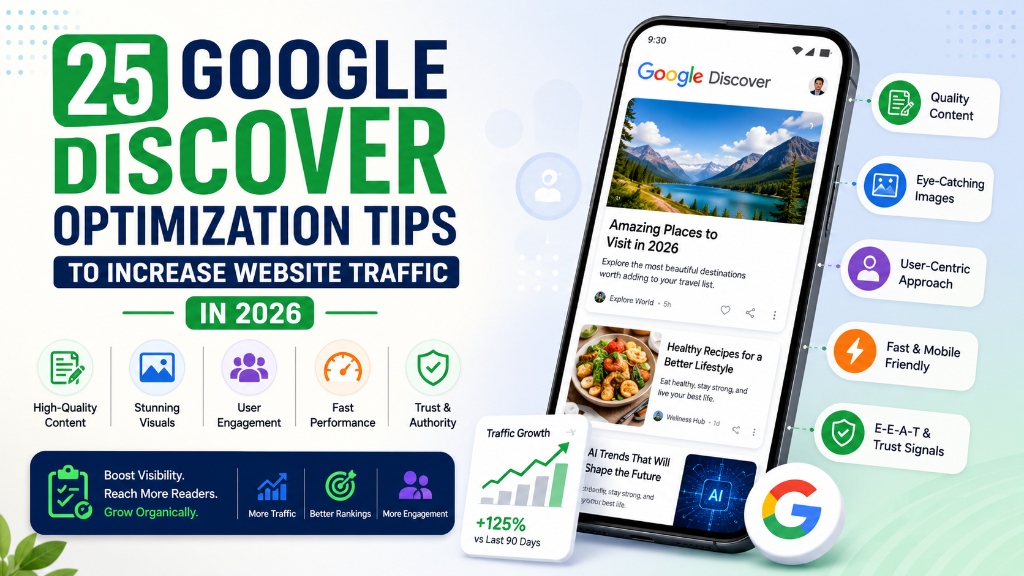
Google Discover has become one of the most powerful sources of organic traffic for publishers, bloggers, businesses, and content creators. Unlike traditional Google Search, where users actively search for information, Google Discover proactively recommends content based on users' interests, browsing behavior, and engagement.
Appearing in Google Discover can drive thousands of additional visitors to your website without relying solely on search rankings. However, getting featured requires more than publishing quality content. Your website must demonstrate authority, trustworthiness, strong user engagement, and an excellent page experience.
In this guide, you'll learn 25 Google Discover Optimization Tips to Increase Website Traffic in 2026. These practical strategies will help improve your chances of appearing in users' Discover feeds and growing your organic audience.
What Is Google Discover?
Google Discover is a personalized content recommendation feed available on the Google app, Chrome mobile browser, and some Android devices. Instead of displaying results based on a search query, Discover recommends articles, videos, and other content that align with a user's interests and online activity.
The Discover feed uses Google's artificial intelligence and machine learning systems to identify content that users are likely to find useful, engaging, and relevant.
Content featured in Google Discover may include:
- Blog articles
- News stories
- Evergreen guides
- Videos
- Product updates
- Educational content
- Industry insights
Because recommendations are personalized, different users will see different content in their feeds.
Why Google Discover Matters for SEO
Google Discover offers unique opportunities to increase organic visibility beyond traditional search.
Benefits include:
- Increased website traffic
- Greater brand exposure
- More returning visitors
- Improved content visibility
- Higher engagement
- Additional organic traffic without relying only on search rankings
For many publishers, Discover can become one of the largest traffic sources when content consistently meets Google's quality standards.
1. Publish High-Quality Content
Quality remains the foundation of Google Discover. Create content that solves real problems, provides accurate information, offers unique insights, delivers value to readers, and demonstrates expertise. Helpful content has a better chance of being recommended.
2. Create Original Content
Google prioritizes original reporting, research, opinions, and insights. Avoid simply rewriting information already available on other websites. Instead, publish case studies, original research, industry analysis, personal experience, and expert opinions. Originality helps differentiate your content.
3. Write Attention-Grabbing Headlines
Your headline is one of the first elements users notice. A good headline should clearly explain the topic, spark curiosity, avoid clickbait, and include relevant keywords naturally. Compelling headlines improve click-through rates.
4. Use High-Quality Featured Images
Large, attractive images significantly improve Discover visibility. Use high-resolution, professional-quality images that are relevant to the content and have a minimum recommended width of 1200 pixels. Strong visuals encourage user engagement.
5. Focus on E-E-A-T
Google Discover favors trustworthy websites. Strengthen your Experience, Expertise, Authoritativeness, and Trustworthiness. Include author biographies for experts like Balamurugan P, contact information, and accurate sources where appropriate. Learn more about solid E-E-A-T signals in our SEO Strategies Guide.
6. Build Topical Authority
Publish multiple high-quality articles around one topic to show deep expertise. A strong content cluster including Technical SEO, Local SEO, AI SEO, and Google Discover demonstrates authority. Check your site structure using our SEO Audit Checklist.
7. Improve Website Speed
Fast-loading pages create a better experience. Optimize images, CSS, JavaScript, hosting, caching, and CDN usage. Performance improvements benefit both Discover and traditional search, as outlined in our Website Speed Optimization Guide.
8. Optimize Core Web Vitals
Maintain strong performance for Largest Contentful Paint (LCP), Interaction to Next Paint (INP), and Cumulative Layout Shift (CLS). Excellent page experience increases user satisfaction. Find out how in our Core Web Vitals Guide.
9. Make Your Website Mobile Friendly
Google Discover is primarily used on mobile devices. Ensure your website uses responsive design, loads quickly, has readable fonts, and supports touch navigation. Mobile friendliness is essential for modern search, see Responsive Web Design.
10. Publish Evergreen Content
Timely news can appear in Discover, but evergreen content often continues receiving recommendations long after publication. Examples include SEO guides, tutorials, checklists, how-to articles, and best practices. Evergreen content provides long-term traffic opportunities.
11. Update Content Regularly
Google Discover favors fresh, relevant content, especially for topics that evolve over time. Regularly improve your articles by updating outdated information, adding recent statistics, including new examples, expanding important sections, and fixing broken links.
12. Optimize for User Interests
Google Discover recommends content based on user interests rather than search queries. Create articles around topics your audience genuinely wants to read by researching industry trends, FAQs, community discussions, and social conversations.
13. Avoid Clickbait Headlines
Misleading titles may generate clicks initially but often reduce user trust. Instead, write headlines that are accurate, clear, interesting, honest, and relevant. Google values content that delivers on its headline.
14. Improve User Engagement
Engaging content encourages users to spend more time on your website. Increase engagement by using visuals, adding infographics, including screenshots, breaking content into smaller sections, and using bullet points and checklists.
15. Add Author Information
Clearly display the author's name, biography, experience, profile photo, and contact details. Showing that a qualified specialist like Balamurugan P wrote the content strengthens trust and aligns with Google's E-E-A-T principles.
16. Use Structured Data (Schema Markup)
Schema Markup helps Google better understand your content. Useful schema types include Article, FAQ, Organization, Person, and Breadcrumb. While schema doesn't guarantee Discover placement, it improves content understanding. Read our Schema Markup Guide for details.
17. Optimize Internal Linking
Connect related articles naturally to improve discovery. For example, your Google Discover guide can naturally link to other technical pieces like Internal Linking Strategies or Technical SEO Checklist to build a cohesive information structure.
18. Build Brand Authority
Well-known and trusted websites are more likely to appear in Google Discover. Strengthen your brand by publishing consistently, maintaining content quality, sharing expert insights, being active on professional platforms, and building industry recognition.
19. Encourage Returning Visitors
Google values websites that users repeatedly engage with. Encourage return visits by publishing consistently, creating content series, updating existing guides, adding related articles, and offering practical resources.
20. Improve Content Readability
Easy-to-read content keeps users engaged. Best practices include short paragraphs, clear headings, simple language, bullet points, tables where appropriate, and a logical content flow.
21. Publish Consistently
Consistency helps establish your website as an active source of valuable information. Create a publishing schedule, such as one article per week or two articles per month, and regularly update existing content to support long-term growth.
22. Monitor Google Search Console
Use the Discover Performance report in Google Search Console to monitor clicks, impressions, click-through rate (CTR), and top-performing Discover pages. Reviewing this data helps identify which content resonates with your audience.
23. Follow Google's Content Policies
Avoid content that may reduce eligibility for Discover, including misleading headlines, excessive advertising, thin or low-value content, copied content, and sensational or deceptive information.
24. Promote Content Across Multiple Channels
Although Discover recommendations are generated by Google, promoting your content can increase visibility and engagement. Share articles through LinkedIn, Facebook, X (formerly Twitter), newsletters, and industry communities.
25. Prioritize User Value Over Algorithms
The most effective Discover strategy is simple: create content that people genuinely want to read. Focus on solving real problems, answering common questions, providing practical advice, sharing original insights, and maintaining accuracy.
Common Google Discover Optimization Mistakes
Avoid these common issues that can reduce your chances of appearing in Google Discover:
- Publishing Low-Quality Content: Thin or generic articles rarely perform well in Discover.
- Using Misleading Headlines: Clickbait titles may reduce user trust and engagement.
- Ignoring Mobile Optimization: Since Discover is primarily mobile-based, poor mobile usability can limit visibility.
- Using Low-Quality Images: Small, blurry, or irrelevant images reduce visual appeal.
- Publishing Infrequently: Long gaps between updates may reduce audience engagement.
- Ignoring E-E-A-T: Websites lacking expertise, author information, or trust signals may struggle to gain visibility.
- Failing to Update Existing Content: Outdated content becomes less relevant over time.
- Poor User Experience: Slow pages, intrusive pop-ups, confusing navigation, and excessive ads can negatively affect engagement.
Google Discover Optimization Checklist
Before publishing your content, review this checklist:
- ✅ Publish high-quality, helpful content
- ✅ Create original insights
- ✅ Write compelling, accurate headlines
- ✅ Use high-resolution featured images
- ✅ Demonstrate E-E-A-T
- ✅ Build topical authority
- ✅ Optimize website speed
- ✅ Optimize Core Web Vitals
- ✅ Ensure mobile friendliness
- ✅ Publish evergreen content
- ✅ Keep content updated
- ✅ Focus on audience interests
- ✅ Avoid clickbait
- ✅ Improve user engagement
- ✅ Display author information
- ✅ Implement Schema Markup
- ✅ Strengthen internal linking
- ✅ Build brand authority
- ✅ Encourage returning visitors
- ✅ Improve readability
- ✅ Publish consistently
- ✅ Monitor Discover performance in Search Console
- ✅ Follow Google's content policies
- ✅ Promote content responsibly
- ✅ Always prioritize user value
Frequently Asked Questions (FAQs)
1. What is Google Discover?
Google Discover is a personalized content feed that recommends articles, videos, and web pages based on a user's interests, browsing history, and engagement. Unlike Google Search, users don't need to enter a query—Google proactively suggests relevant content. Discover is available in the Google app, Chrome on Android, and some mobile devices.
2. How can my website appear in Google Discover?
There is no manual submission process for Google Discover. Your content becomes eligible when it meets Google's quality standards. To improve your chances, publish high-quality, original content, use large, high-resolution featured images, demonstrate E-E-A-T, build topical authority, optimize website speed, ensure mobile friendliness, publish consistently, and focus on user interests.
3. Does Google Discover use keywords?
Not in the same way as traditional Google Search. While keywords still help Google understand your content, Discover primarily recommends articles based on user interests, browsing behavior, content quality, engagement signals, and topic relevance. Creating valuable content for your audience is more important than keyword density.
4. Are backlinks required to appear in Google Discover?
No. Backlinks are not a direct requirement for Discover eligibility. However, strong backlinks can improve your website's authority and trust, making your content more likely to perform well across Google's platforms. Focus on earning high-quality, natural backlinks instead of building links solely for Discover.
5. What image size is recommended for Google Discover?
Google recommends using large, high-quality images with a width of at least 1200 pixels. For best results, use original images, avoid blurry or pixelated visuals, choose visually engaging featured images, and ensure the image accurately represents the content. Compelling images improve click-through rates in Discover.
6. How often should I publish content for Google Discover?
Consistency is more important than volume. Publishing one or two high-quality articles each week, while regularly updating existing content, is generally more effective than publishing large amounts of low-quality content. Maintain a consistent publishing schedule to build audience trust and long-term visibility.
7. Can evergreen content appear in Google Discover?
Yes. Although timely news often performs well, evergreen content can continue appearing in Discover for months or even years if it remains relevant, helpful, and regularly updated. Guides, tutorials, checklists, and educational resources are excellent examples of evergreen content.
Conclusion
Google Discover has transformed the way users consume content by recommending articles based on interests rather than search queries. This creates an excellent opportunity for businesses, bloggers, and publishers to reach new audiences and generate significant organic traffic.
Success in Google Discover isn't achieved through shortcuts or keyword manipulation. Instead, it comes from consistently publishing high-quality, original, and engaging content that provides genuine value. Websites that demonstrate expertise, maintain strong technical performance, use compelling visuals, and focus on user experience are more likely to earn visibility in Discover.
The 25 Google Discover Optimization Tips covered in this guide provide a practical roadmap for increasing your chances of being featured. From creating original content and improving page experience to building topical authority and strengthening trust signals, every optimization contributes to long-term growth.
As Google's AI continues to personalize content recommendations, the websites that consistently educate, inform, and solve real user problems will have the greatest opportunity to succeed. Focus on your audience first, and let quality guide every piece of content you publish.
Increase Your Website Traffic with Google Discover Optimization
Want to expand your organic reach beyond traditional search results?
At balamurugan.in, we help businesses create content strategies that improve visibility across Google Search, Google Discover, AI-powered search experiences, and other organic channels. Connect with Balamurugan P today to optimize your digital marketing campaigns.