Table of Contents
- Introduction
- What Is AI Search?
- Why AI Search Is Growing Rapidly
- Traditional Search vs AI Search
- Why Businesses Should Care About AI Search
- The Evolution of SEO
- How AI Understands Search Intent
- AI Search Ranking Factors
- Building Topical Authority
- AI SEO Strategies Every Business Should Follow in 2026
- Technical SEO Still Matters
- Structured Data and Schema Markup
- Voice Search Optimization
- Common SEO Mistakes in the AI Era
- AI SEO Checklist
- Preparing Your Business for the Future
- Conclusion
Introduction
Search engine optimization (SEO) has evolved significantly over the past decade, and 2026 marks another major milestone with the rapid growth of artificial intelligence in search. Users no longer rely solely on traditional search results that display a list of web pages. Instead, AI-powered search engines are delivering direct, conversational answers by understanding context, user intent, and the relationships between topics.
This transformation is changing how businesses approach SEO. Ranking on the first page of search results is still valuable, but success now depends on creating high-quality, trustworthy, and user-focused content that AI systems can easily understand and reference.
For businesses of all sizes, adapting to AI-powered search is essential for maintaining online visibility and attracting qualified traffic. Companies that continue using outdated SEO practices may struggle to compete, while those that embrace AI-friendly strategies can strengthen their authority and improve long-term organic growth.
In this guide, you'll learn how AI search is reshaping SEO in 2026, why it matters for your business, and what practical steps you can take to optimize your website for the future.
What Is AI Search?
AI Search is a new generation of search technology that uses artificial intelligence, machine learning, and natural language processing to understand user intent and provide meaningful answers.
Instead of simply matching keywords, AI analyzes the context of a query, evaluates reliable sources, and generates responses that are conversational and relevant.
For example, if someone searches: "What is the best SEO strategy for a small business?"
- A traditional search engine typically displays a list of websites.
- An AI-powered search engine can summarize the most useful recommendations, explain the reasoning behind them, and provide links to trusted resources.
This creates a faster, more personalized search experience while encouraging businesses to publish comprehensive and trustworthy content.
Why AI Search Is Growing Rapidly
User behavior has changed dramatically in recent years. Instead of typing a few keywords, people now ask complete questions such as:
- How can I improve my Google rankings?
- What is the difference between SEO and AI Search?
- Which SEO strategy works best in 2026?
- How do I optimize my website for AI?
AI search engines are designed to understand these conversational queries and provide detailed answers.
Several factors are driving the adoption of AI-powered search:
- Better User Experience: AI delivers faster and more accurate answers by understanding context instead of relying only on keywords.
- Voice Search Growth: People increasingly use voice assistants on smartphones and smart devices to ask natural language questions.
- Personalized Results: AI can tailor search responses based on context, preferences, and previous interactions.
- Improved Understanding: Modern AI models recognize relationships between topics, making search results more relevant than ever before.
As AI continues to improve, businesses that publish valuable, well-structured content will be more likely to appear in AI-generated responses.
Traditional Search vs AI Search
Although both approaches aim to help users find information, they operate differently.
| Traditional Search | AI Search |
|---|---|
| Focuses on keywords | Focuses on user intent |
| Displays website links | Generates direct answers |
| Depends on page rankings | Depends on content quality and authority |
| Exact keyword optimization | Context and semantic optimization |
| Blue links | Conversational responses |
| User visits multiple websites | AI summarizes information instantly |
Traditional SEO remains important, but AI Search adds another layer by rewarding websites that provide complete, trustworthy, and well-organized information.
Why Businesses Should Care About AI Search
Businesses that ignore AI Search risk losing visibility as search behavior evolves. Optimizing for AI-powered search offers several advantages:
- Increased Online Visibility: AI systems frequently reference websites that consistently publish authoritative and high-quality content.
- Better Qualified Traffic: Visitors arriving through AI-generated recommendations often have stronger purchase intent because they have already received initial information.
- Improved Brand Authority: Being recognized as a trusted source helps strengthen your reputation within your industry.
- Better User Experience: Creating content that answers real questions improves engagement, reduces bounce rates, and encourages users to explore additional pages.
The Evolution of SEO
SEO has changed significantly over the years:
- Early SEO: Search engines relied heavily on keyword repetition, making it easy to manipulate rankings.
- Backlink Era: Backlinks became one of the strongest ranking signals, leading businesses to focus on acquiring links from other websites.
- User Experience Era: Google began prioritizing fast-loading websites, mobile responsiveness, and valuable user experiences.
- AI Search Era: Today, AI-powered search evaluates websites based on user intent, content quality, experience, expertise, trustworthiness, website performance, topical authority, freshness of information, and structured content.
SEO is no longer about simply ranking for keywords. It is about becoming the most reliable source of information for users.
How AI Understands Search Intent
Search intent is the reason behind a user's query. AI analyzes language patterns, context, and previous interactions to determine what users are actually trying to achieve.
For example, someone searching: "Best SEO company for local businesses" may want:
- Service comparisons
- Pricing information
- Customer reviews
- SEO strategies
- Consultation options
Instead of focusing on a single keyword, businesses should answer every related question users may have.
AI Search Ranking Factors
Although ranking algorithms continue to evolve, AI-powered search generally favors websites that demonstrate:
- Helpful Content: Answer questions clearly and provide actionable advice.
- Expertise: Publish accurate information backed by real experience.
- Authority: Cover your niche consistently through interconnected content.
- Trustworthiness: Maintain accurate, transparent, and regularly updated information.
- Fresh Content: Update important pages to reflect the latest trends and best practices.
- Strong User Experience: Ensure your website loads quickly, works well on mobile devices, and is easy to navigate.
Building Topical Authority
Publishing one article about SEO is no longer enough. Businesses should create a network of related content covering every aspect of their niche.
For an SEO website, this might include:
- What Is SEO?
- Keyword Research Guide
- On-Page SEO Checklist
- Technical SEO Guide
- Local SEO Strategies
- Link Building Best Practices
- Google Search Console Guide
- Core Web Vitals Explained
- AI SEO Optimization
- SEO Audit Checklist
Connecting these articles through internal links helps search engines understand your expertise while improving the user experience. When your website consistently publishes valuable content around related topics, both search engines and AI systems are more likely to recognize it as an authoritative source.
AI SEO Strategies Every Business Should Follow in 2026
As AI-powered search continues to evolve, businesses need to move beyond traditional SEO practices. Ranking for keywords alone is no longer enough. Modern SEO focuses on creating valuable content that answers user questions, demonstrates expertise, and provides a great user experience.
1. Focus on Search Intent Instead of Keywords
Traditional SEO often prioritized exact-match keywords. While keywords still help search engines understand your content, AI systems place much greater importance on the user's intent.
For example, someone searching for "best SEO services for startups" may be looking for startup-friendly pricing, agency comparisons, case studies, reviews, or expected results. Instead of targeting a single keyword repeatedly, create content that answers all these related questions naturally.
2. Create Comprehensive, Helpful Content
AI-powered search engines prioritize content that provides complete answers. Instead of publishing multiple short articles targeting similar keywords, create detailed guides that cover a topic from every angle. A comprehensive guide should cover introductions, definitions, benefits, step-by-step layouts, practical examples, and FAQs.
3. Build Topical Authority
Publishing a single blog about SEO is not enough. Search engines prefer websites that demonstrate expertise across an entire subject. Build supporting articles around keyword research, technical SEO, local SEO, content marketing, and connect them strategically through internal links.
4. Prioritize E-E-A-T
E-E-A-T stands for Experience, Expertise, Authoritativeness, and Trustworthiness. These principles help search engines and AI systems determine whether your content is reliable. To improve E-E-A-T, share practical insights, publish original research, keep content accurate, and clearly identify the author.
5. Optimize for AEO (Answer Engine Optimization)
Answer Engine Optimization (AEO) helps your content appear in AI-generated answers, voice search, and featured snippets. Instead of writing long paragraphs without structure, provide direct answers immediately below question-based H3/H4 headings to make it easy for AI scrapers to extract information.
6. Optimize for GEO (Generative Engine Optimization)
Generative Engine Optimization (GEO) focuses on improving your content's visibility in AI-powered search experiences. Unlike traditional SEO, GEO emphasizes how AI systems understand, summarize, and recommend information. Support your claims with data, write naturally, and organize content clearly.
Technical SEO Still Matters
Although AI has transformed search, technical SEO remains essential. Even the best content may struggle to rank if your website has technical issues. Focus on page speed, mobile optimization, HTTPS, XML sitemaps, robots.txt, canonical tags, and structured internal linking.
Structured Data and Schema Markup
Structured data helps search engines better understand your content. Important schema types include Article Schema, FAQ Schema, Organization Schema, Breadcrumb Schema, and Local Business Schema. Implemented correctly, schema improves your chances of appearing in AI summaries.
Voice Search Optimization
Voice searches are becoming increasingly common. Instead of typing "SEO Chennai", people ask "Who provides the best SEO services in Chennai?". To optimize for voice, write conversationally, answer complete questions, and use long-tail keywords.
Common SEO Mistakes in the AI Era
Many businesses still rely on outdated practices that limit their visibility. Avoid keyword stuffing, publishing thin content, ignoring user intent, poor website speed, weak internal linking, outdated information, and copying competitor content without providing original insights.
AI SEO Checklist
- ✔ Targeted the correct search intent
- ✔ Written a compelling introduction
- ✔ Used descriptive H2 and H3 headings
- ✔ Included internal links
- ✔ Added external references where appropriate
- ✔ Optimized images and alt text
- ✔ Added FAQ sections
- ✔ Implemented schema markup
- ✔ Improved page speed
- ✔ Reviewed grammar and readability
Preparing Your Business for the Future
Artificial intelligence will continue to shape how users search for information online. Businesses that invest in quality content, technical SEO, topical authority, and user experience today will be better prepared for tomorrow's search landscape. Focus on creating content that genuinely helps your audience, combining traditional SEO with AI-ready optimization strategies.
Frequently Asked Questions
AI Search is an advanced search technology that uses artificial intelligence to understand user intent and provide direct, conversational answers instead of only displaying a list of web pages. It analyzes context, relevance, and content quality to deliver the most useful information.
Yes. Traditional SEO remains essential for improving website visibility. Factors such as keyword research, technical SEO, high-quality content, backlinks, and website performance continue to influence rankings. However, businesses should also optimize for AI-powered search experiences to stay competitive.
SEO focuses on improving a website's visibility in traditional search engine results. AEO (Answer Engine Optimization) helps content appear in AI-generated answers and voice search results. GEO (Generative Engine Optimization) focuses on optimizing content for AI-powered search engines by making it comprehensive, trustworthy, and easy for AI models to understand.
Businesses should publish original, people-first content, focus on search intent, improve technical SEO, implement structured data, build topical authority, optimize for mobile devices, and update content regularly. These practices help improve visibility in both traditional and AI-powered search results.
No. AI Search is transforming how users discover information, but it is not replacing traditional SEO. Instead, it enhances SEO by prioritizing helpful, trustworthy, and well-structured content. Businesses that combine traditional SEO with AI optimization strategies will achieve the best long-term results.
AI-powered search is becoming an important part of the online search experience. Businesses that adapt early by creating valuable, authoritative content and improving their websites will be better positioned to increase organic traffic, build trust, and stay ahead of competitors.
Key Takeaways
- AI Search focuses on understanding user intent rather than just matching keywords.
- High-quality, helpful, and trustworthy content performs better in AI-powered search.
- Traditional SEO remains important but should be combined with AEO and GEO strategies.
- Building topical authority through related content improves long-term rankings.
- Technical SEO, structured data, and mobile optimization continue to play a vital role.
- Businesses that adapt to AI Search early will gain a competitive advantage in the future.
Conclusion
Artificial intelligence is reshaping the future of SEO, making search more intelligent, conversational, and user-focused. While traditional optimization techniques remain valuable, businesses must now think beyond rankings and create content that genuinely helps users solve problems.
Success in 2026 depends on publishing comprehensive, trustworthy, and experience-driven content while maintaining strong technical SEO and an excellent user experience. Websites that consistently provide valuable information, answer user questions, and demonstrate topical authority are more likely to be recognized by both search engines and AI-powered search platforms.
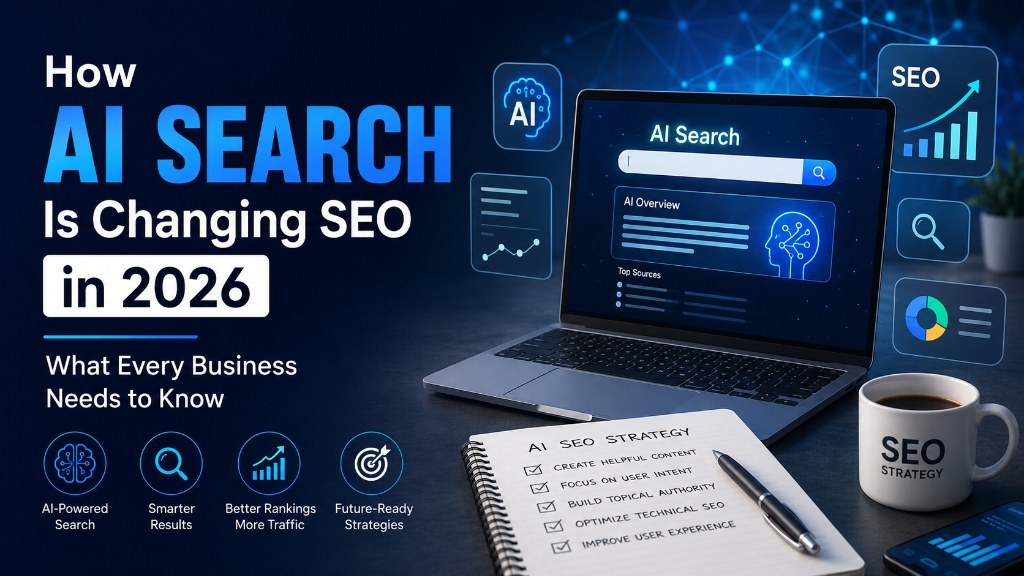
The future of SEO is not about replacing traditional strategies—it's about enhancing them with AI-ready practices. By focusing on user intent, content quality, structured data, and continuous optimization, businesses can improve their online visibility and generate sustainable organic growth.